Week of Prayer for Christian Unity: Conversations on “Called to hope”

Courtesy of the Focolare’s Western European WhatsApp Channel. Contribution by Revd Callan Slipper


We mark the Week of Prayer for Christian Unity during challenging times. Last year many Christians were ‘Pilgrims of Hope’ during a special year for the whole Church. The world needs hope more than ever now so why end our pilgrimage? Hope is a rare and precious gift in divided and dangerous times.

One way to refocus hope could be sitting in on a conversation between two friends. They reflect on ‘Called to Hope’, an event in Rome they attended last March, hosted by the Focolare Movement. This brought together many Christians from all over the world and widely differing traditions.

In these two YouTube videos, Revd Dr Callan Slipper, Churches Together in England Chair of Trustees, and retired United Reformed Church minister, Revd Martin Smith, share their thoughts on the Rome gathering and its legacy.

As we mark the Week of Prayer for Christian Unity, and refresh our prayers for the whole of creation, these conversations help us to refocus on the importance of hope.

Week of Prayer for Christian Unity: Conversations on Hope

Part 1

Part 2


Christmas 2025

Christmas greetings from Margaret Karram and Jesús Morán – President and Co-president of the Focolare Movement.

In a time, which is still marked by divisions of every kind, may the joy of serving, sharing and reciprocity be renewed in all of us this Christmas, through real gestures, especially towards those who suffer. We want to commit ourselves to live a Christmas characterised by fraternity and closeness, by sowing hope for the future.

https://www.youtube.com/watch?v=tGUlJWteq98Christmas greetings from Margaret Karram and Jesús Morán – President and Co-president of the Focolare Movement.

In a time, which is still marked by divisions of every kind, may the joy of serving, sharing and reciprocity be renewed in all of us this Christmas, through real gestures, especially towards those who suffer. We want to commit ourselves to live a Christmas characterised by fraternity and closeness, by sowing hope for the future.


7 December 1943: the beginning of a divine adventure

Chiara Lubich describes the day she consecrated herself to God.

On the 7th of December 1943 I went to church alone. There was a violent storm outside. It really gave me the impression that I had the world against me. (…) A small kneeler had been prepared for me before the altar, and I had a tiny missal in my hands. The priest had me pronounce the formula to give myself completely to God forever. I was so happy that I probably didn’t even realize what I was doing, maybe because I was young. However, when I pronounced the formula, I had the impression that a bridge was falling behind me and that I could no longer turn back because now I belonged entirely to God, therefore, I could no longer choose. At this point, a tear fell on my missal.

But my happiness was immense! Do you know why? I was marrying God, and I expected every possible good. It would be a divine, extraordinary adventure! I was marrying God! And later we saw that it had really been just that.

(…) What is my advice? I would give this advice to myself: we have only one life. Let’s aim high. Let’s risk everything to gain everything. It’s worth it, it’s worth it. So make this act of generosity: aim high, don’t hold back!

Excerpt taken from: Chiara Lubich, The fourth way, 30 December 1984

Photo: © Horacio Conde – CSC Audiovisivi

Source: www.focolare.org


Reinventing Peace

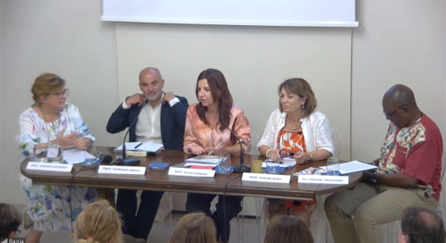
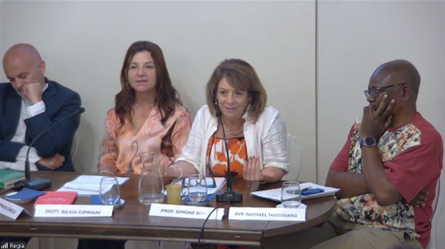
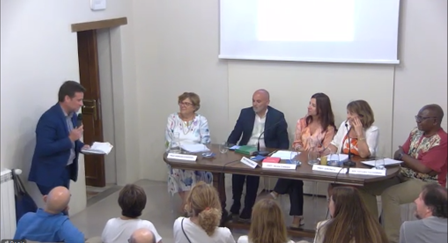
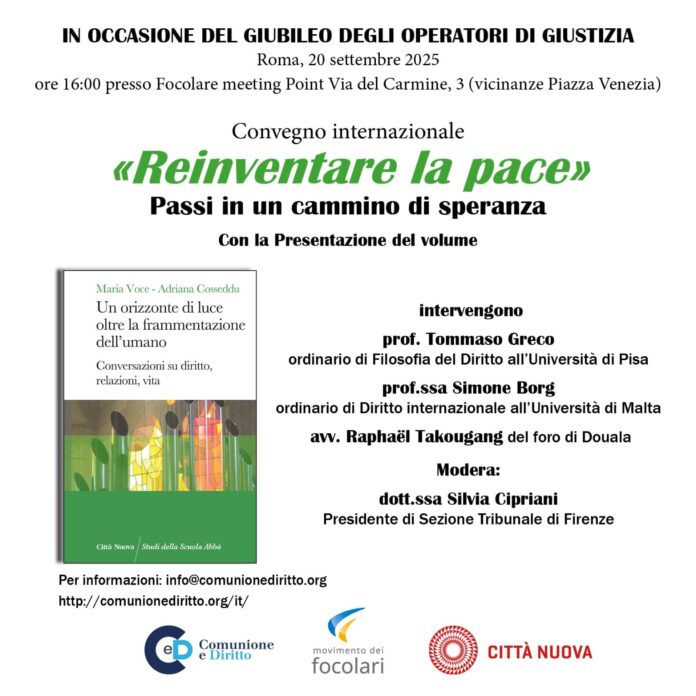
Conference organised by Communion & Law on the occasion of the Jubilee Year of Justice, entitled: “Reinventing Peace – Steps forward in a journey of hope”.

by Prof. Simone Borg
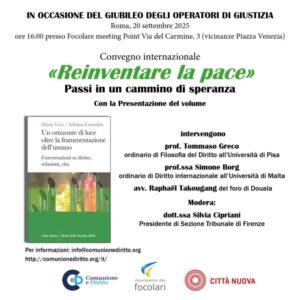
This address, delivered at the seminar “Re-inventare la Pace – Passi in un Cammino di Speranza” (Reinventing Peace – Steps forward in a journey of hope) and the launch of the book Un’Orizzonte di Luce oltre la Frammentazione dell’Umano: Conversazioni su Diritto, Relazione e Vita, explores the evolving role of law in society, the interplay between individual and collective rights, and the necessity for peace-oriented multilateralism rooted in people’s participation. Drawing on personal, professional, and academic insights, especially the legacy of Maria Voce and Prof Adriana Cosseddu, Prof Simone Borg examines how law, when centred on relationships and fraternity, can be a beacon of hope and justice in a fragmented world.

The book’s chapters are organised around themes that scrutinise the function of law in contemporary society, tackling both enduring and emerging challenges. A central element is the inclusion of candid dialogues conducted by Maria Voce, engaging with politicians, academics, civil society, and young people across different regions. These dialogues begin with the fundamental question, “what is law?”, and traverse its purpose, philosophy, and the pitfalls of legal fragmentation—especially when lawmakers neglect the balance between individual and collective rights.

Prof Simone Borg, explained how as a Maltese lawyer she studied and worked with a legal system based upon Roman Law, which is renowned for its simplicity. During her career, she noticed the evolution of straightforward norms to an increasingly complex and super specialised body of law. Despite this proliferation, the speaker asserts that it is the quality, not the quantity, of laws that underpins an effective rule of law. An abundance of legislation does not guarantee justice or the proper functioning of society.

She argues that in fact the contributors to Un’Orizzonte di Luce question whether the sheer volume of legal norms enhances or diminishes the law’s efficacy. They examine whether the plurality of laws—reflecting diverse cultures and traditions—provides substance, procedural fairness, and effective governance. The book’s strength she argues, lies in its range of perspectives, with contributors from various backgrounds considering legal topics of universal significance. This diversity underscores the fundamental question: is law merely a system of legislation and enforcement, or does it serve a greater purpose for humanity?
Despite this diversity, a unifying thread runs through the book: the law’s true purpose (ratio legis) is not simply to impose limits, but to foster relationships and trust. The prevailing view is that a restrictive interpretation of law’s purpose leads to disillusionment and a failure to secure peace and justice, even as laws multiply. True well-being—both private and public—requires law to transcend mere order and punishment, and instead to unlock its potential to construct meaningful relationships, from individuals to the international community. Law, in this vision, is a tool for peace, security, and well-being.

This innovative approach is inspired by the experiences of Maria Voce and Adriana Cosseddu with the Focolare Movement, founded by Chiara Lubich. The “Focolare”, meaning the hearth, symbolises nurturing relationships for the benefit of all. Legal practice, when illuminated by Gospel values, prompts a re-examination of the ultimate role of law—and indeed any discipline—as a means to generate life and respond creatively to adversity.

The book validates the law as a social science from a relational perspective. Contributors ask whether law is currently fulfilling its role as the medium for nurturing relationships, particularly in protecting the vulnerable. Law should be an instrument of enlightenment, ensuring dignity, justice, peace, and security at both national and international levels. Relationships are seen as an endowment, binding human beings as members of society and stewards of the planet. The book’s outlook is future-oriented, as seen in its engagement with young people and institutions like the United Nations.

Prof Borg argues that the message in the book is consistent throughout: law must be a conduit for fraternal relationships, overcoming conflicting interests and barriers to peace at all levels. Legal systems that facilitate fair, equitable relationships can foster global coexistence and societal well-being.

The classic maxim “Ibi Societas ibi Jus” (where there is society there is law) can be recast as “Ibi Homo ibi Jus” (where there is humanity there is Law). Individual and community rights are interdependent; law’s mission is to guarantee that no one is left behind, allowing all to participate equally in society. Rights should not compete, but coexist in a reciprocal relationship, the foundation of a just and inclusive society.

The book also addresses the proliferation of laws in response to conflict resolution, constitutional rights, and new legal complexities—ranging from environmental crises and data protection to artificial intelligence and the digital society. Law-making is often the default response to threats to dignity and liberty, but the book argues for a clear delineation of responsibilities and for institutions that foster integration in a multicultural society, promoting peace.

Institutional encounters are proposed to nurture a juridical culture of peace, tolerance, and reconciliation, warning against the uncritical delegation of legal responsibility to technology. While technology can be positive, its use must be underpinned by legal frameworks that guarantee accessibility and safety, ensuring it serves humanity.

Prof Borg then shares her personal professional experience, reflecting on the question whether international law and multilateralism serve governments or the people. Multilateralism, often seen as a challenge to national interests, is reimagined as a force for humanity, not just statecraft. She argues that the preamble of the United Nations Charter — “We the peoples of the United Nations determined…”—is highlighted as a deliberate emphasis on people’s agency in multilateralism. The Charter enshrined the choice of multilateralism over unilateralism, aiming to “practice tolerance and live together in peace”, with multilateralism by and for the people as the path to these goals.

Multilateralism’s democratic core is its inclusion of diverse voices—civil society, communities, and public consultation are now integral to multilateral debates. At the UN, civil society’s role in high-level dialogues exemplifies progress towards peace. Diplomacy, traditionally the preserve of states, now increasingly values the participation of non-state actors, especially in tackling global challenges like climate change. For example, the International Court of Justice’s recent advisory opinion affirms that protecting the climate is an “erga omnes” obligation—owed to all of humanity, present and future.

Law should aim to foster also responsibility among people and not just rights.  Prof Borg argues that when people stand up to demand a change, like the call for climate justice coming from the grass roots for example, the same people clamouring for such a noble cause must ask themselves the question: how can I change to fulfil my duty towards climate justice?  Civil society’s engagement would be truly credible and a game changer, when we as citizens shoulder the responsibility as individual citizens, leading by example and acknowledge the need to change our behaviour to achieve climate justice. Only such a recognition of the concomitant obligation to a claim of a rights, can ward off populist governments, which cite “national” interest to oppose essential reforms to achieve climate justice, essential for humanity’s very survival.

The dialogues throughout the book propose the human family—fraternity—as the horizon for law’s ultimate goal: a just society. When fraternity is used as the yardstick for assessing legal systems, law can truly instill freedom and equality. Prof Borg concluded by explaining that the book offers a way forward, encouraging lawmakers and practitioners to reappraise their vocation as guardians of social conscience and inspiring citizens to recognise their role in upholding justice. The rule of law depends not only on legislation but also on the commitment of all—law-makers, practitioners, and citizens—to anchor freedom and equality in human fraternity, for present and future generations, and for the planet itself.
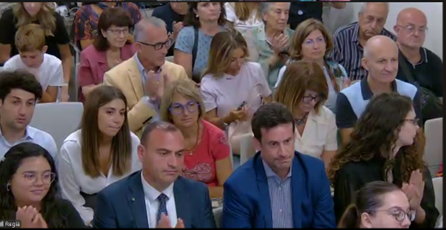
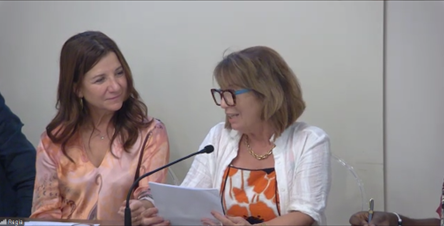


Focolare Annual Report 2024: “You did it to me”

Over €9.6 million have been invested in 177 projects, 394 individual grants and 14 projects in 13 countries supported by the Economy of Communion. The Focolare Movement’s 2024 Assessment of Communion in Action describes projects of solidarity which aim to make a better world.

Rome, 6 November 2025 – The Focolare Movement today presented its 2024 Bilancio di Comunione (Sharing of Goods Report) at the Pontifical Patristic Institute Augustinianum in Rome, under the title “L’avete fatto a me” (“You did it to me”). Inspired by the Gospel message of Matthew 25:40, the report offers a living testimony to concrete acts of fraternity carried out across the world — initiatives that arise from the Movement’s charism of unity and respond to the pressing needs of our time, in strong partnership with civil society, faith communities, and international organisations.

In her opening remarks, Margaret Karram, President of the Focolare Movement, highlighted the profound link between faith, social engagement, and hope: “Beyond numbers and projects, what this report reveals is a global family committed to seeing Christ in every person, especially in those who are most vulnerable, and to building paths of justice, peace, and human dignity.”

The event featured contributions from Sr. Alessandra Smerilli, Secretary of the Dicastery for Promoting Integral Human Development and Moira Monacelli of Caritas Internationalis. Representatives from five initiatives rooted in the Focolare’s spirituality shared their transformative experiences:

Fo.Co. ONLUS (Sicily, Italy), supporting migrants and unaccompanied minors;

UNIRedes, a network of 74 social organisations in Latin America and the Caribbean;

Focolare Carpentry Training Centre (Philippines), providing vocational training and job opportunities for disadvantaged youth;

TogetherWeConnect (Israel and Palestine), offering training in dialogue and peace-building;

Centro Medico di Man (Ivory Coast), delivering healthcare in a fragile post-conflict region.

These stories of change are drawn from the wider Annual Report which this year documents over 200 initiatives in fields ranging from education to ecological transition, migration support to prisoner accompaniment, youth empowerment to social business. Each project is rooted in the spirituality of unity, with a strong emphasis on shared responsibility, co-creation, and sustainable impact.

The report aligns closely with global frameworks including the UN’s Sustainable Development Goals, Pope Francis’ encyclicals Laudato Si’ and Fratelli Tutti.

The “You did it to me” report offers a compelling witness: that real change is possible when communion becomes a lived reality — a shared good that multiplies hope.

For more information and to access the full report, visit: www.focolare.org


Audience with Pope Leo XIV

On 26 September 2025, Margaret Karram and Jesús Morán were received by Pope Leo XIV.

“We went to the Pope this morning to share with him the life of the Movement and to listen to what he had to say to us,” said Margaret Karram and Jesús Morán, President and Co-President of the Focolare Movement at the end of a private audience with Pope Leo XIV. “It was a meaningful, personal and fraternal meeting. He was interested to hear about our work for peace, for ecumenical and interreligious dialogue, for the dialogue with cultures and, especially, for communion between ecclesial movements. He encouraged us to continue spreading the charism throughout the world.”

“At the end,” says Margaret Karram, “I asked him if we could bring his blessing to all those belonging to the Movement. ‘Certainly!’ he replied.”

Source: https://www.focolare.org/in-udienza-con-papa-leone-xiv/

Watch the special coverage of the audience with Pope Leo XIV on the worldwide linkup streamed live on Saturday,27 October 2025.


16 July: Margaret Karram’s message on the day of the Pact of Unity

The 16th of July is a significant day for the Focolare Movement. In fact, it is the anniversary of the Pact of Unity between Chiara Lubich, foundress of the Movement, and Igino Giordani, whom she considered a co-founder. It took place on the 16th of July 1949.

On this anniversary, Margaret Karram, President of the Focolare Movement, addressed the following message to all those who belong to the Movement around the world.


Thank you Emmaus!

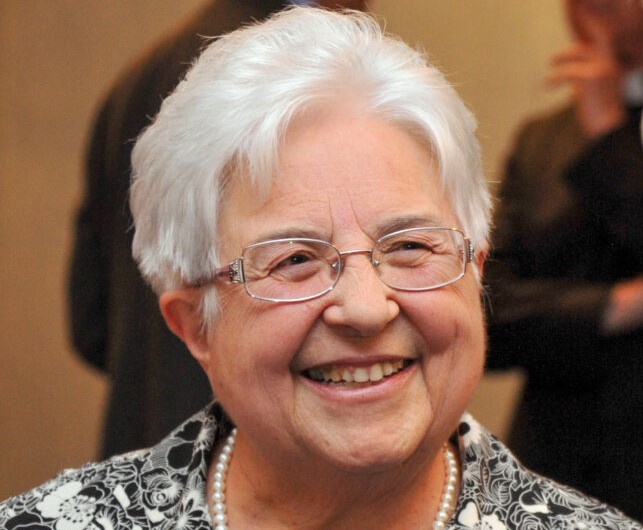
Letter from Margaret Karram, President of the Focolare Movement, on the occasion of the departure of Maria Voce – Emmaus.

Dear everyone,

I am writing to you with great sorrow and profound emotion to inform you that today, at 5.22 pm, God called to Himself our Emmaus, Maria Voce, the first president of the Focolare Movement after Chiara Lubich.

She concluded her holy journey in Rocca di Papa, in her home, surrounded by the care and love of the focolarine of her focolare and the prayers of us all. Today, in the early afternoon, Jesús and I were able to visit her for one last time. She was serene.

A great affection and immense esteem bind me to her because of her donation to God in the Work of Mary right to the end.

Since my election as President, her closeness, which was so discreet but ever present, always accompanied me, supporting me with her advice so full of Wisdom. She was present on the most varied occasions, celebrations, anniversaries, journeys; she assured me of her prayers, the offering of her life and often she would send me a gift, a flower or one of her poems.

She received the name “Emmaus” from Chiara, recalling the experience of the Risen Lord walking with us. This name characterised her whole life. Indeed, she affirmed: “How do we do the Work of God? With Jesus in the midst!”

Her inspiring faithfulness to Chiara’s charism, her courage in facing numerous challenges, and her belief in unity, in communion, remain etched in our hearts.

Her human, spiritual and sapiential calibre has been acknowledged by the most varied religious and civil authorities: from Pope Benedict XVI and Pope Francis; from the leaders of the various Churches to representatives of other religions and cultures.

Her funeral will be held on Monday, 23rd of June at 3.00 p.m. (Italian time) at the International Centre in Rocca di Papa.

Let us remain united in the love that binds Heaven and earth!

Margaret Karram
Rocca di Papa, 20 June 2025

Download the letter


“Recognising Oneself, The Statutes: a Path and a Mirror”: Lesson 5

The final lesson of the UPM 2025 course, “Recognising oneself The Statutes: a path and a mirror”, was transmitted on Saturday 10th May and is available to watch here.

Lesson 5 explored the Statutes from several international perspectives, drawing on the insights of canon lawyers and experts.

The key themes and perspectives covered were:

Juridical, Ecclesiological, and Charismatic Reading of the Statutes:
Cristiane Ganda Ribeiro (Brazil), a canon lawyer, discussed how the statutes defined the Work of Mary as a private universal association of pontifical right. She explained its relationship with the Catholic Church and emphasized that the statutes reflected the charism of unity that was central to the Focolare Movement. The Statutes are not merely legal documents but also an expression of the Movement’s spirituality and mission.

Structure of Zones, Branches, and Movements:
Rafael Tagugang (Ivory Coast), a lawyer specializing in canon law and Zone Delegate of Western & Central Africa, examined the parts of the Statutes that pertain to the organization of the Focolare Movement in zones, branches and various movements within it. He underscored the importance of unity and synodality in the structure of the organization and highlighted how the statutes ensured spiritual and operational unity between the central administration and the local zones.

Dialogue with Other Churches and Beliefs:
Elfriede Glaub (Germany), a Canon lawyer and Diocesan Judge, analysed the sections of the statutes that addressed the Focolare Movement’s engagement in dialogue with other Christian churches, ecclesial communities and people of non-religious convictions. She emphasized the inclusion of non-Catholic Christians and followers of other religions within the Work of Mary and the importance of seeking their input in relevant decisions.

In essence, the final lesson of the course, and this summary, emphasized that the Statutes are a vital tool for understanding the Focolare Movement’s identity, structure, and mission. It encouraged engagement with the Statutes to better understand one’s role within the Work of Mary and to contribute to its mission of unity in diversity. The Statutes provide a framework for governance that serves unity and for living out the charism of love in freedom and responsibility.

Lesson on YouTube:
https://youtu.be/74hh3LNoGUw?si=YoBiUyIogmSivxLU


Margaret Karram, President of the Focolare Movement, expresses joy upon the election of Pope Leo XIV

On behalf of the Focolare Movement throughout the world, I express my great joy for the election of Pope Leo XIV as the new Pontiff of the Catholic Church. We thank God for having listened to the prayers of so many people and having, with His Spirit, guided the work of the Cardinals in identifying the successor of Peter at the present time that is posing serious challenges for humanity.

Right From now, we want to assure the Holy Father of our filial closeness, our prayers and our commitment to be peacemakers, as he repeatedly emphasised in his first blessing.

Today the world is in urgent need of peace, light and hope. That is why we promise that we will continue to commit ourselves, together with the ecclesial communities in which we are inserted, to bring God’s love to all; to be open to dialogue, to be ‘one people always at peace’, bearing witness to the fact that the unity asked for by Jesus in his Testament is stronger than any division.

Moreover, we want to commit ourselves to embodying the synodal path ever more faithfully, to be able to apply it also in the various areas of society; to give our contribution so that the Church may be an open and welcoming home for every man and woman and for the new generations, especially for those who are most fragile, those who suffer most and those who are marginalised, so as to offer to all the ever new message of Christ.

Best wishes Pope Leo XIV, with all our love!

Margaret Karram
President of the Focolare Movement

Download the press release