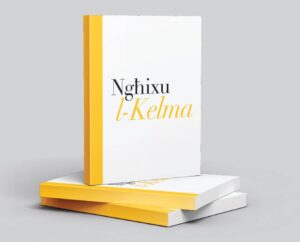
New publication in Maltese: “Ngħixu l-Kelma” (Living the Word)

The publication collects 100 Word of Life commentaries written by Chiara Lubich during the period 1943-2008.


The Word of Life is part of the great literary heritage left to the Focolare Movement by Chiara Lubich. She herself gave birth to the idea of ​​this leaflet, which is more than a commentary on Gospel passages; it is a charismatic writing, an intuition, a light, which motivates the reader to live the Word of God and translate it into life.

From the beginning, the Word of Life was written with the intention of reaching everyone, and therefore it was always presented as a modest leaflet, and it was written in a language that everyone can understand, with an incisive and direct style.

Over the years, this simple initiative has offered a valuable contribution for the Christian world to discover or re-discover the Word of God, while offering a “method” of living the Word and sharing with others the fruits of living it out.

In this book, one will find a selection of 100 Words of Life, taken from a collection of around 350 that Lubich wrote during 60 years of life, and in which one will find some of the spiritual legacy she left behind.

Introduction by: Msgr Charles Jude Scicluna, Archbishop of Malta


© Moviment tal-Fokolari, Malta
© Fondazzjoni Dinja Magħquda – Moviment tal-Fokolari (Malta)
ISBN: 978-9918-0-0656-4
Price: €10

The book is available from:

Emmaus Bookshop, Birkirkara
(tel: +356 2149 8343)


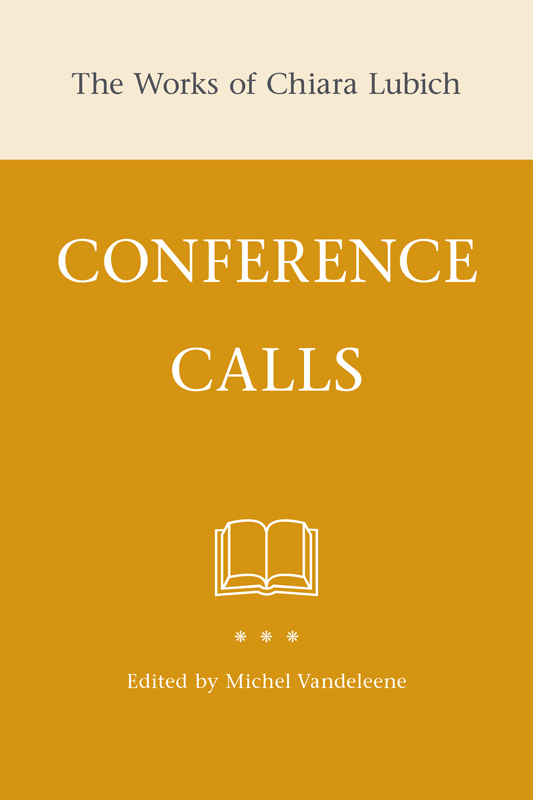
Conference Calls

The Works of Chiara Lubich – part 8/1

Conversations with Chiara Lubich via Telephone and Satellite Connections

For 24 years Chiara Lubich nourished spiritually the many people born from her charism with the thoughts of her Conference Calls. Twice a month it brought countless people together in a kind of virtual cenacle. There was no better opportunity of renewing the commitment they had made together to make life a ‘holy journey’.

For Chiara holiness does not so much exist in removing our faults one by one, but in loving, in thinking of others, in forgetting ourselves. In this way she formed the members of the Focolare Movement for a life of communion.

Unity is the ‘high point of the Gospel’, and Pope John Paul II saw the task of ‘making the Church the home and school of communion’ as the great challenge of the third millennium, as an educative principle in every place of formation, and this not only for Christians but for everyone.

‘The Works of Chiara Lubich’ forms a corpus of works that presents in a systematic way the patrimony of Chiara Lubich’s thought, drawing on both published material, as well as a large amount that has not yet been published. A copious literary heritage, that expresses, in terms of experience and content, her thought, her life and her very existence.

Available from: New City Publishing


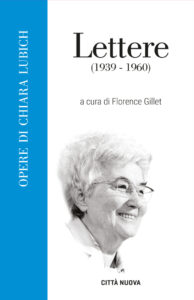
“Letters 1939-1960”: Getting to know Chiara Lubich through her letters

A volume of Chiara Lubich’s works entitled “Letters 1930-1960” has been on sale in Italian bookshops for several months. We spoke to Florence Gillet from the Chiara Lubich Centre, a theologian and scholar of the Focolare Movement, who is the editor of the publication.

The book contains 338 letters (a selection of the many letters written by Chiara Lubich) that bring the reader into direct contact with the early years of the nascent Focolare Movement and the development of its charism. “I advise everyone to make the effort,” Florence continues, “to start reading from the introduction, to grasp the key to the reading, and then continue with the letters, one by one, in an orderly way, letting them ‘speak to the heart’”.

The reader will find letters to individuals, letters to growing communities, letters to members of her family; They will find other letters that are more doctrinal, in which Chiara explains her newfound ideal. “Producing this book has been a fascinating project,” she concludes, “and I think readers will find it fascinating too”.

Read complete article

Enquiries and orders: Città Nuova website


Words of Life

The volume of Words of Life is more than a commentary on the gospel message, it is a charismatic reading, an intuition, and an invitation to put the words of Scripture into practice in everyday life. It is part of a series of 13 books.

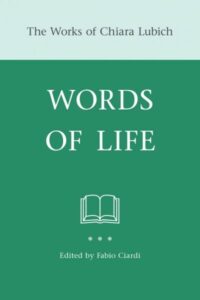
Words of Life

The Works of Chiara Lubich – part 5

by Chiara Lubich

This book entitled, Words of Life, is unique in that it contains a complete compilation of Chiara Lubich’s written commentaries on Scriptural passages. These constitute what could be called a separate work within her extensive literary production. Being destined to reach a large audience, they were always printed as simple leaflets and were written in a style that would be understandable by people of every social class.
However, they are more than simple commentaries on the Gospel. They are charismatic readings, intuitions and flashes of inspiration and unexpected joy. They provide a decisive impetus to help people start living the Gospel. Chiara Lubich’s immediate, incisive and direct style created a new literary genre. In its simplicity, the Word of Life initiative made a significant contribution to the rediscovery of the ‘word of God’ in the twentieth century, first in the Catholic world and then among Christians worldwide.

The edition edited here by Fabio Ciardi collects these Words of Life (about 350 in total), which cover a period of more than 60 years, from the early beginnings of the evangelical experience of the Focolare Movement’s founder (the first commentary dates back to 1943) until 2006. They have been translated into 96 different languages.

The destiny of the Word is ‘to be “eaten” in order to give life to Christ in us and to Christ among us.’ The Word is much more than food. It is like the air we breathe, without which we cannot live. Chiara writes of the experience at the beginning of the Movement:

‘We were nourished by it in every instant of our life, just as the body breathes in order to stay alive, so the soul lived the word in order to stay alive.’

Published in April 2022

Available from: New City Publishing


New City Magazine

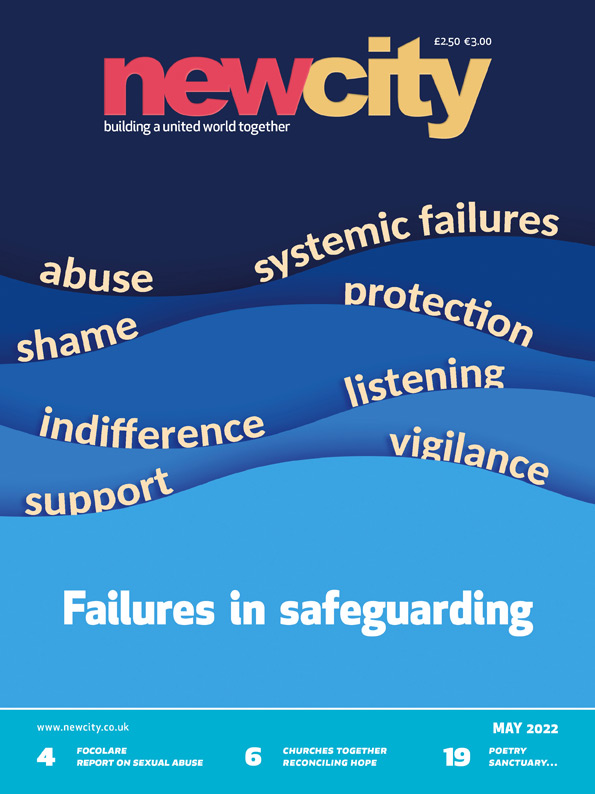
New City is the magazine of the Focolare Movement in Great Britain, published monthly, except in August and September when only one issue is published (11 issues a year)

New City Magazine

Over the last seven decades Focolare has grown from a small community of around five hundred in Trent, northern Italy, to a world-wide community of several hundred thousand people of all ages and backgrounds. It has also spread beyond the confines of the Roman Catholic Church, to many other Christian traditions, to other faiths and people of good will.

New City works to promote mutual understanding and respect through dialogue. Together with our readers we want to discover how to ‘build bridges’ in the different sectors of society and in personal life. We are convinced that dialogue, based on mutual love, is the only way to build a more united world which is based on universal values such as justice, equality, truth and peace.

For more information and to subscribe to the publication, visit: New City Magazine


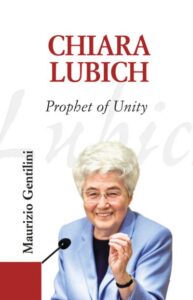
Chiara Lubich – Prophet of Unity

Author Maurizio Gentilini

This biography aims at presenting Chiara Lubich’s life and work from a ‘historical’ perspective, offering the reader a rich and well-documented development of facts, situations and experiences.

Description

Chiara Lubich (1920–2008) is considered one of the most significant leaders in ecumenical, interreligious and intercultural dialogue. Because of her lifelong commitment to build bridges among individuals, generations and nations, she received numerous awards, including the Templeton Prize for Progress in Religion (London 1977), the UNESCO Prize for Peace Education (Paris 1996) and the Human Rights Award of the Council of Europe (Strasbourg 1998).

This biography aims at presenting her life and work from a ‘historical’ perspective. For this reason she is presented within the framework of historical events that have occurred in her life and in the geographical setting of the places and contexts in which she travelled, from her birth up to her death in 2008.

The author presents a woman who, often unconsciously, shows a deep perception of the ‘signs of the times’ of Christianity and of the contemporary world, expressing them through her thoughts and actions, publications and works, giving rise in a relatively short time to the Focolare Movement spread throughout the world.

The book is divided into four parts, each of which offers the reader a rich and well-documented development of facts, situations and experiences. It is a captivating succession of ‘lights and shadows’, typical of a journey reserved for people who, in the history of humanity – and in particular in the history of the Church – leave an imprint on the times in which they lived.

The publication of this book hopes to make Chiara known from an unusual angle, so far never explored, but nevertheless important. It is the perspective of the twentieth century, which closes the second millennium, a century that, to its credit, counts an innumerable series of great personalities who have marked this important epochal passage with their life and their thought.

Available from New City (UK)


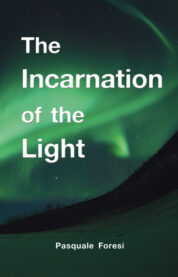
The Incarnation of the Light

Published by New City (UK)

Copies available from the Focolare Centre in Kappara – 15

A commentary on the 12 points of the spirituality of unity

The charismatic gifts that God bestows from age to age on the world are always linked to specific circumstances and persons who act as mediators of those gifts at the service of the Church and of humanity.

Pasquale Foresi, the first focolarino priest and its first co-president, is in a certain way such a person. The founder of the Focolare Movement, Chiara Lubich, always recognised in him a particular plan of God, namely that of the incarnation, i.e. the task of giving tangible expression to the many intuitions that the Holy Spirit inspired her with.

The texts that this book offers would like to help all of us assume responsibility for incarnating the prayer of Jesus, ‘that all may be one’, according to the multiplicity of gifts that God has given us. They highlight the twelve points of the ‘spirituality of unity’ of the Focolare Movement that flow from that prayer.

Focolare Movement that flow from that prayer.

1 God-Love
2 The will of God
3 The Word
4 Love for our neighbour
5 Mutual love
6 The Eucharist
7 Unity
8 Jesus forsaken
9 Mary
10 The Church
11 The Holy Spirit
12 Jesus in our midst


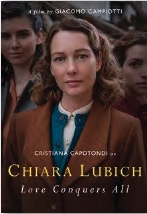
DVD: “Chiara Lubich: Love Conquers All”

An engaging Italian film about Chiara Lubich (1920-2008), “Chiara Lubich: Love Conquers All” tells the story of Lubich, the founder of the Focolare Movement. The young teacher’s life in Trent, Italy, suddenly changes when Allied forces drop bombs on her city. Amid the violence of the Second World War, Chiara hears God’s call to become a lay consecrated woman — something unheard of at that time. Through the study of Scripture, Chiara realizes that she must become the hands and feet for Christ to help the poor and rebuild people’s faith in humanity. However, she doesn’t achieve her calling without resistance and suffering.

Portraying the life of Chiara Lubich, the founder of the Focolare Movement, this powerful movie tells the dramatic story of the spiritual and human adventure of a young teacher from Trento, Italy, who, amidst the devastation and despair from the bombings of World War II, was called to build a better, more united world, becoming a strong witness and advocate of universal brotherhood as a prerequisite for dialogue and peace among men. Directed by the acclaimed filmmaker Giacomo Campiotti (Mary of Nazareth; St. Philip Neri), it reveals a charismatic figure who chose love as the compass of life, and found her mission and purpose through the passage from the Gospel, “May they all be one.”

With her message of friendship and relief towards her neighbor, especially the poor and suffering, without distinction of race or religious belief, Chiara greatly contributed to renewing the Church and society, becoming a light in the darkness through the work of the Focolare Movement, which continues her legacy today throughout the world. Her mission had the full support of all the Popes in her lifetime, and she had particular close collaboration with Pope John Paul II. Her cause for sainthood has been opened in Rome.

Format:DVD
ISBN/UPC:817531010862
Publication date: October 01, 2021
Duration: 107 minutes
Weight: 8.1 oz

Price: $19.95 (in Italian with English subtitles, or an English dubbed track)

Available from: ignatius.com


Why another biography on Giordani?

This is the question we asked  Prof. Alberto Lo Presti and Dr Elena Merli, members  of the Igino Giordani Centre, editors of “Igino Giordani: an unarmed hero” (Città Nuova Publications).
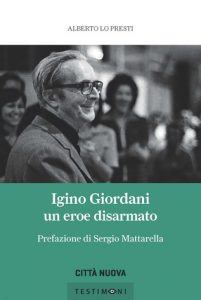
So many biographies have been written about Igino Giordani. Why another one?

Elena Merli: The previous biographies cover a limited time span of Giordani’s life. The first biography was written in 1936; then there was the one written by Tommaso Sorgi, a friend of Giordani who studied him in great depth. Sorgi wrote an inspired and detailed biography that deals with Giordani’s life from birth to 1948. Other biographies analysed  Giordani’s life from a particular perspective: historical, spiritual, political…. They are all valuable; they are a great richness, but this biography deals with a holistic perspective of his life. It speaks about aspects that were very little explored until now, namely: his family life, his deep relationship with Chiara,  the  particular period of intense illumination that was “Paradise ’49”. Even his experience as a member of the Dominican Third Order had not yet been explored in depth. Some of the political background of his life had not yet emerged, nor were some of his intimate choices and delicate passages of his personal life. I would like to point out particularly the novelty of a chapter dedicated to what he jokingly called “Giordania”, that is, his family. I think many will enjoy reading about the secrets of Igino’s lively family situation.

The first thing that strikes you in this book is its prestigious preface signed by Sergio Mattarella, the President of the Italian Republic. Why him?

Alberto Lo Presti: It is good to know a few things from behind-the-scenes. First of all, Sergio Mattarella knew Igino Giordani personally, and he says something about this in the preface. Then, one must remember that his father, Bernardo Mattarella was the author of the first biography written in 1936. So, all this helped to ask him  write the preface.

Then, we think that Sergio Mattarella is interpreting the role of President of the Republic as a source of unity in Italy and in the international field. During this  health crisis, he has been a figure of stability and high morality.

Giordani gave  witness to unity in politics and harmony among people. The parts of the book dedicated to his political commitment describe his behaviour during the war and in the post-war period, under bombings and fascism, amidst the rubble of reconstruction and social distress. Those times were not any calmer or more peaceful than the ones of today. Giordani’s steadfastness can still help us to understand where to go today.

This volume is the result of intense archival research work. Do we know everything about Giordani now?

Elena Merli: We have an impressive amount of material, documents, correspondence, and also audio and video recordings of many of Giordani’s talks, public and confidential ones, transcribed and sorted out. All these proved extremely useful to discover details about his personal life.

Who knows how many more new and interesting discoveries we can still make by exploring the archive! Many are already in this book. I’ll mention just one: details about Giordani’s last years, when he lived in this building, the International Centre of the Focolare Movement. At that time, the Focolare community of Antonio Petrilli occupied the first floor of this building, and in 1974, after the death of his wife Mya, Giordani moved to live with this community. These unpublished details reveal Igino’s faithfulness to community life and the depth of his humanity.

To whom is this book addressed?

Alberto Lo Presti: It addresses all those who want to solve the mystery of mysteries, that is, of how to be totally donated to God while immersed in the ordinary things of the world.

Giordani managed to do this and he traced the way for us. He always questioned himself about it ….. but when he met Chiara Lubich he also found the answers. For Igino, Chiara was the answer to all his existential questions. He studied early Christian writers, medieval theologians, modern theologians, great spiritual figures, yet he found the answers in Chiara and in the spirituality of communion.

I would like to recount one of the many anecdotes, which many do not know; one can find it in the book.

Giordani had such a great desire to donate himself to God that at the end of the 1920’s he joined the Dominican Third Order. But he was not satisfied … the rule for members was at least one Mass a month, a sermon by one of the monks and nothing more. He wanted to be more involved in religious life. So he submitted his idea to the monks: rent a flat where they could all meet: “you in your cassock (the monks’ cassock) and we, (the lay members) in our trousers. Thus, we can have some community life together”. He was told that this was not in the norms of the Dominican order and it stopped at that. What Giordani yearned for at the end of the 1920’s became a realty through Chiara; it was the focolare. Yes, in 1928 when such episodes happened, he was dreaming of the focolare. Incredible, isn’t it?

Edited by Lorenzo Russo

Publication available from  Città Nuova


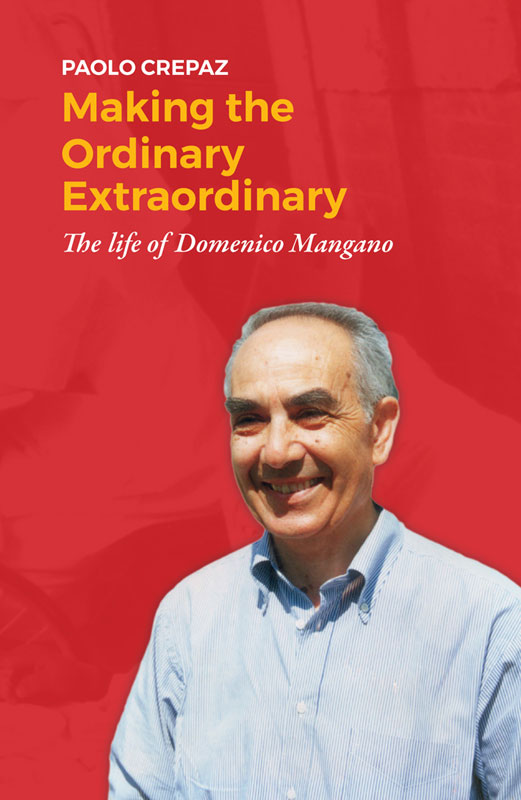
Making the Ordinary Extraordinary: The Life of Domenico Mangano

Domenico Mangano lived his life in such a way as to communicate God’s love to all who crossed his path.

Author: Paolo Crepaz

Domenico Mangano believed deeply in the love of God. He lived his life in such a way as to communicate God’s love to all who crossed his path – his family, his work colleagues, his clients and his fellow politicians. His was an extraordinary life lived out in ordinary, everyday circumstances. He saw in his relationship with every person a chance to bring about the unity which Jesus had prayed for.

Domenico was able to live to the full… and he has transmitted his passion for unity to many, valuing every moment of daily life.’

Chiara Lubich

The pages of this book also reveal the depth of Domenico’s political commitment where he promotes the idea of loving the party of the other as one’s own.

For sales and enquiries: New City Press London

Also available from the Focolare Centre in Malta