Pope Francis: All in Christ

Jesús Morán, Co-President of the Focolare Movement, reflects on the years of his pontificate and highlights the “golden thread” that has woven his mission in guiding the Church.

It is with deep emotion that I write these lines about Pope Francis after his “flight” to the Father. I recall those many thoughtful and meaningful moments, when I was able to shake his hand and feel the warmth of his smile, the tenderness of his gaze, the strength of his words, the beating of his heart ready for a fatherly welcome. And I find it hard to believe that these encounters will no longer have a “tomorrow” or an “again” in my life.

I do not propose to make a thematic summary of Francis’ pontificate. To this end, it will be enough to review the many articles that have been published in recent days, especially the special issue of L’Osservatore Romano – just a few hours after his death – and the more or less exhaustive evaluations that will surely be published in the near future.

What moves me from within is to find that the golden thread that weaves his mission in guiding the Church, to try to be in tune with the centre of his heart and soul. And, from there, to relive the relationship he had with the Work of Mary during these twelve years.

To do this, I meditated deeply on his most recent talks, because I feel that this is where Pope Francis gave the best of himself and where you can find the key to all his thinking and to all his actions.

In the text he prepared for the Easter Mass, there is a quote from the great French theologian Henri de Lubac, who is also a Jesuit, that cannot simply be rhetorical: “it should be enough to understand this: Christianity is Christ. No, truly, there is nothing else but this.”

In my opinion, if we want to understand Francis, we must refer to this absolute: Christ, and only Christ, all Christ. From this we can understand the profound content of his encyclicals and apostolic exhortations, the choice of his journeys, his preferred options, the meaning of the reforms he undertook, his gestures, his words, his homilies, his meetings, and above all his love for those who are excluded, for those who are rejected, for women, for the elderly, for children and for creation.

‘No, there really is nothing else’. That is why one can say – using a pleonasm – that the Catholicism of Pope Francis is simply a “Christian Catholicism”. The new impulse he wanted to give the Church is based on this approach: the transparency of Christ. Because of this, on many occasions he has gone far beyond the politically correct, or rather, the ecclesially correct, without fear of being misunderstood, and without fear of being wrong, even aware of his “contradictions”. In fact, in an interview with a Spanish newspaper he said that what he wished for his successor was not to make his same mistakes.

Because of this Christological centrality, we can acknowledge that we have indeed been living – almost without realising it – with a Pope who is profoundly mystical. After all, this is how Pope Francis has thought and lived the Church: not as a religious organisation, nor as a distributor of sacraments, much less as a centre of economic, social or political power, but as the people of God, the body of Christ, which gives hospitality to humanity in His humanity. A Church, therefore, that is open to humanity, to service, because Jesus is “the heart of the world”.

To reduce Francis to a social reformer or a Pope of disruption shows a tremendous blindness. I often stared at his face when he inserted comments in his messages, for example at the Sunday Angelus. There, with the simplicity of a shepherd who passionately loves his flock, he displayed his harmony with the divine, his wisdom, his crystal-clear and straightforward faith, his profound humility.

In my humble opinion, from the centrality of Christ derive the two fundamental pillars of his magisterium: mercy and hope. Mercy is the expression of knowing ourselves as believers rooted in history, both personal and collective, with all its tragedies; hope manifests the eschatological and salvific tension that determines it. According to the Pope’s thought, there is mercy because there is hope; and it is hope that gives us a heart of mercy. Indeed, in his homily prepared for this year’s Easter Vigil, Francis affirms that ‘the Risen Christ is the definitive turning point in human history’. The important social and ecological messages of Pope Francis are misunderstood if this eschatological tension centred on the Risen Lord is not taken into account.

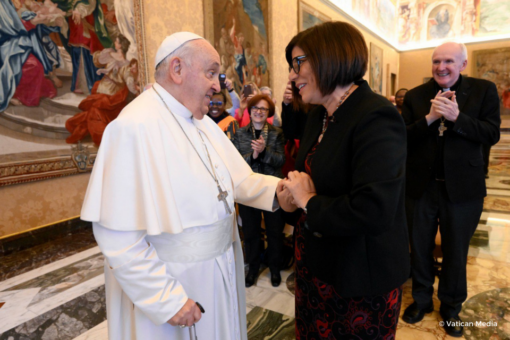
Francis’ relationship with the Focolare Movement has been very deep during the twelve years of his pontificate. He addressed ten official speeches to it: to the participants at the 2014 and 2021 Assemblies; to all those belonging to the Movement on the occasion of the 80th anniversary of its birth; to the academic community of the Sophia University Institute; to the family-focolares; to the participants at the meeting of the bishops of various Churches; to the participants at the meeting on the “economy of communion”; to the participants at the interreligious conference “One Human Family”; to the citizens of the little town of Loppiano; to the Mariapolis of Rome – Earth Village. Furthermore, on one occasion, he granted a private audience to Maria Voce, the first president of the Work of Mary after Chiara, and to myself.

What emerges from these meetings is a great love and a touching pastoral concern of Pope Francis for the Movement. In the virtual ecclesial circularity between hierarchical and charismatic gifts, we can affirm that, on the one hand, the Pope has been able to grasp, value and highlight the gift that the charism of unity, with its emphasis on the spirituality of communion and its concrete achievements in very different ecclesial and civic contexts, represents for the synodal process that the whole Church is living in view of a new evangelisation. On the other hand, he has identified with extreme clarity the challenges and steps that the movement must necessarily take if it wants to remain faithful to its original charism, knowing how to go through the inevitable post-foundation crisis in a humble way, transforming it into a time of grace and new opportunities.

Pope Francis has been for the world an all-encompassing message of fraternity rooted in Christ and open to all. Fraternity is the only future that is possible. We, the people of unity, must treasure this legacy with humility, energy and responsibility.

Jesús Morán

Photo © Vatican Media
Source: https://www.focolare.org/en/pope-francis-all-in-christ/


Pope Francis: We are filled with gratitude for his extraordinary example

Rocca di Papa, Rome, 21 April 2025

The condolences of Margaret Karram, President of the Focolare Movement on the death of the Holy Father Francis.

It was with deep sorrow that I learned of the return to the house of the Father of our beloved Pope Francis. Together with the whole Church, we give him back to God, filled with gratitude for the extraordinary example and gift of love that he has been for every person and every people.

There have been many moments, throughout his entire pontificate, in which the Holy Father has been a close and loving shepherd also for the Focolare Movement. He has always welcomed us and has guided us to witness to the Gospel with courage and in a radical way.

We have lived many moments with him, which we will never forget. In one of them we remember his words to the General Assembly of the Focolare, when he received us in audience in 2021:

‘Always listen to Christ’s cry of abandonment on the cross, which manifests the highest measure of love. The grace that comes from this, is capable of inspiring in us, who are weak and sinners, generous and sometimes heroic responses. It is capable of transforming suffering and even tragedy into a source of light and hope for humanity’.

Finally, I cannot fail to testify also to the Pope’s love and personal concern for me, for the sufferings of my people in the Holy Land, and my immense gratitude for having invited me to participate in the Synod on Synodality, where he himself opened the doors of the Synodal Church that is now starting to take its steps throughout the world.

Together with the entire Focolare Movement in the world, I unite myself to the prayer of the universal Church and of all men and women of good will, certain that Our Lady “Salus Populi Romani”, (Mary, Health of the Roman People) to whom he was so devoted, will welcome him into heaven with open arms.

Margaret Karram
President of the Focolare Movement

Source: https://www.focolare.org/en/thank-you-pope-francisco/


Thank you, dear Pope Francis

We have just received the news that Pope Francis has gone to meet the Father, after a sacred journey during which he gave authentic witness as a shepherd and disciple of the Lord and servant of the Church.

Thank you, dear Pope Francis, for your closeness — also towards our Movement. Through your words and actions, you have taught how to love in a selfless way, until the very end, with a heart open to all.

Thank you for all your efforts to help our world recognise the one true path of unity and peace.

Thank you for the rich spiritual legacy you have left behind — one that will surely continue to be a great inspiration to the Church and to the world.

May the Lord grant you eternal peace and joy, and may Mary, Mother of the Church, welcome you into her embrace.


Pope Francis to the Focolare: “The world needs artisans of peace”

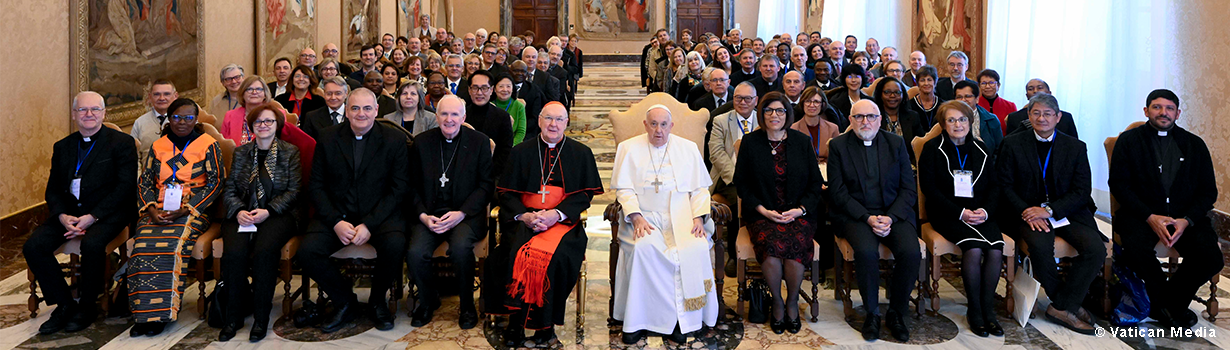
On the morning of 7 December 2023, Pope Francis received in audience Margaret Karram and Jesús Morán, President and Co-President of the Focolare Movement, together with Focolare General Council members and regional delegates, on the occasion of the 80th anniversary of its foundation. Here is the speech that the Pope addressed to them during the audience.

Dear brothers and sisters, welcome!

I greet Cardinal Farrell, your president Dr Margaret Karram, the co-president Jesús Morán, the members of the General Council, the delegates of the geographical areas, and all of you. I am grateful that you came while celebrating the eightieth anniversary of the founding of the Focolare Movement, also known as the Opera di Maria. Thank you!

It coincides with the day on which the Servant of God Chiara Lubich decided to consecrate herself fully to the Lord. From an inspiration she received in an entirely ordinary context of life – while she was going shopping for her family – a radical act of self-giving to God arose, as a response to her call that she had felt, sweet and strong, in her heart. It was 7 December 1943, in Trent, at the height of the war; on the very eve of the Solemnity of the Immaculate Conception, Mary’s “yes” became Chiara’s “yes”, generating a wave of spirituality that spread throughout the world, to tell everyone that it is beautiful to live the Gospel with one simple word: unity. But unity also means harmony: harmonic unity.

In these eighty years, you have made this message resound amid the young, communities, families, persons of consecrated life, priests and bishops; and also in various social environments: from the world of school to that of the economy, from the world of art and culture to that of information and the media; and in particular, in the spheres of ecumenism and interreligious dialogue. You have thus been an active instrument of a great flowering of works, of initiatives, of projects and above all of “rebirths”, of conversions, of vocations, of lives given to Christ and to our brothers and sisters. For all this today we want to give thanks to God.
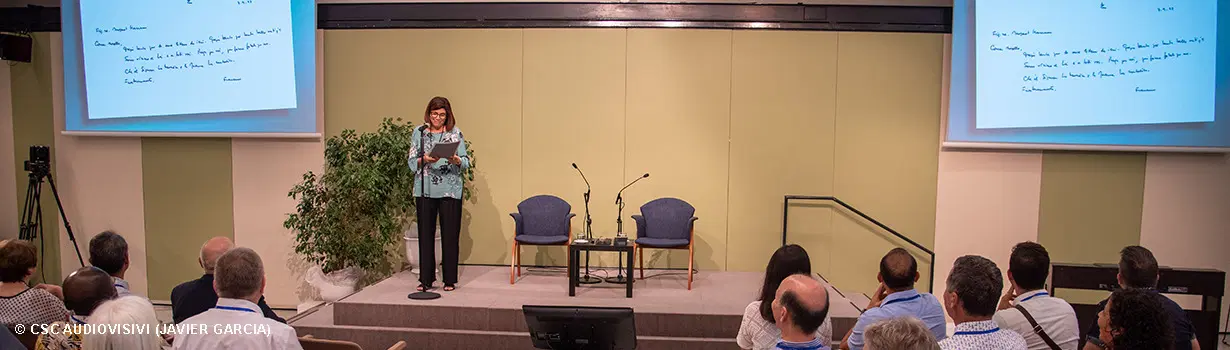
In February 2021, speaking at your General Assembly, I emphasized three important attitudes for your progress: living your charism with dynamic fidelity, welcoming moments of crisis as opportunities to mature, embodying spirituality with consistency and realism (Pope’s address, 6 February 2021). Living spirituality. I want to remember these today to encourage you to live them and promote them along three lines: ecclesial maturityfidelity to the charism, and commitment to peace.

Ecclesial maturity. I invite you to work so that the dream of a fully synodal and missionary Church may be increasingly realized. Start out from your communities, fostering in them a style of participation and co-responsibility, also at the level of governance. Let the “focolare centres”, the hearths, increase within them and spread around them a climate of mutual listening and family warmth, in which we respect and care for one another, with particular attention to those who are weaker and those most in need of support. To this end, it will be helpful for you to pursue avenues of mutual participation and consultation at all levels, paying special attention to communication and sincere dialogue.

With regard to the second line, fidelity to the charism, I remind you of some of your Founder’s words: “Leave to those who follow you only the Gospel. If you do this, the ideal of unity will remain […]. What remains and will always remain is the Gospel, which does not suffer the wear of time” (C. Lubich, in La Parola di Dio, Rome 2011, 112-113). Please, sow unity by bringing the Gospel, without ever losing sight of the work of incarnation that God continues to wish to accomplish in us and around us through his Spirit, so that Jesus may be good news for everyone, no one excluded, and “that all may be one” (Jn 17:21).

And so, we come to the third line, commitment to peace, so important today. Indeed, after two millennia of Christianity, the longing for unity continues to assume the form, in many parts of the world, of an agonizing cry that demands a response. Chiara heard this during the tragedy of the Second World War, and decided to give all her life so that the “legacy of Jesus” might be realized. Today, unfortunately, the world is still riven by many conflicts, and continues to need artisans of fraternity and peace between men and between nations. Chiara said, “To be love and to spread it is the general purpose of the Opera di Maria” (Eve of Pentecost, Saint Peter’s Square, 30 May 1998). Being love and spreading it: this is the main purpose. And we know that only from love is the fruit of peace born.

Therefore, I ask you to be witnesses and builders of the peace that Christ achieved with his cross, defeating enmity. Think that, from the end of the Second World War until now, the wars have not ended. And we are unaware of the tragedy of war. I will confide in you, when I went to Redipuglia in 2014 for the centenary of the First World War, and I saw that cemetery, I truly wept. So much destruction! And every 2nd November I usually go to celebrate in a cemetery, also last time, the Commonwealth Cemetery, and I see the age of the soldiers – 22, 24, 18, 30 – all shattered lives, because of war. And war does not end. And in war, everyone loses, everyone. Only the arms manufacturers gain. And if weapons were not made for a year, world hunger could be brought to an end. This is terrible. We must think about this tragedy.

Before concluding, I would like to make one final invitation, appropriate in this time of Advent: that of vigilance. The snare of spiritual worldliness is always lurking. Therefore, you too need to know how to react decisively, consistently and realistically. Let us remember that inconsistency between what we say we are and what we truly are is the worst anti-witness. Inconsistency. Please, take care. And the remedy is always to return to the Gospel, the root of our faith and our history: the Gospel of humility, of selfless service, of simplicity. And I always like to remember that you are very close to the secret of God, the four secrets of God. God does not understand four things: he does not know how many congregations of religious sisters there are; what the Jesuits think; how much money the Salesians have; and what the Focolarini are smiling about!

Dear brothers and sisters, as we have already recalled, you are the Opera di Maria; she has accompanied you throughout these eighty years and you know well that she will never stop doing so. May the Virgin of Nazareth therefore be the source of your consolation and your strength, so that you may be apostles of unity in the service of the Church and of humanity. Thank you for what you are and for what you do! Continue your journey confidently. I bless you from my heart. And please, do not forget to pray for me. Thank you.

Pope Francis

Source: www.vatican.va


See also:

An 80-year-long adventure

https://www.focolare.org/en/2023/12/06/italiano-unavventura-lunga-80-anni/


Thank you Pope Francis!

On the 10th anniversary of Pope Francis’ pontificate, Margaret Karram, President of the Focolare, has sent the Pope a message on behalf of the whole Focolare Movement which is published below.

Your holiness, dear Pope Francis,

I am united with all the prayers that are being offered, in so many parts of the world, to thank God for these ten years in which you have embraced the Church and humanity being the bearer of Christ’s love.

Thank you, Holy Father, for this time of light, courage and unwavering faith. Thank you for listening to the Holy Spirit, with whom you continuously call us to “go out” from our homes and communities, to journey on the roads of the world and to share joys and sorrows with the women and men of our time.

I still have in my heart the joy and gratitude I felt at our last meeting, on 24 February, when together with some of the moderators of Ecclesial Movements and New Communities, you invited us to meet you. Once again we witnessed your far-sighted wisdom and evangelical realism, and I want to tell you that your words guide and encourage me every day in my service to the Church and to fraternity among all people.

The topics we discussed with you, Your Holiness, will be the subject of reflection and sharing. In particular, your recommendation to be coherent witnesses and to be docile to the new ideas given by the Spirit, so that the Marian dimension of the Church can be seen, together with the rich contribution that women can make to ecclesial life, also through the contribution made by the Movements.

Know that, wherever we are in the world, we are with you to build the Church and to give our lives so that peace may return wherever it is lacking, and bear fruit in justice and reconciliation among peoples.

Together with our daily prayer, I send you, also on behalf of the Focolare Movement, my warmest wishes for all that you desire and for your health. May Mary, Most Holy, be at your side with her motherly love and care.

With filial affection,

Margaret Karram


Focolare zone delegates meeting opens with message from Pope Francis

In addition to the joy of being together again in person after the pandemic, an unexpected and affectionate greeting from Pope Francis has arrived to those with overall responsibility for the Focolare Movement around the world, who are meeting in Rome from 10th  to 23rd  September.

“I am grateful for so much good news. I am close to you personally, and to all of you. I assure you of my prayers, please pray for me too.”

These were the Pope’s words in reply to a letter from Margaret Karram, President of the Focolare Movement, with which she chose to open the meeting of those responsible for the Focolare Movement in the world, together with its General Council.

The President told the 104 people at the meeting that a few days ago she had felt urged to write to the Pope, to thank him for his constant closeness to her and to the Movement, hoping to give him joy. In her letter dated 6th  September, among other things, she told the Pope: ‘A year and seven months have passed since I was elected President, and I confide in you that it has been a very demanding time with many challenges to be faced and many decisions to be made. I have understood more and more your words referring to the ‘pruning’ which is necessary for growth and, as I renewed my choice to embrace Jesus crucified and forsaken in this pruning, I perceived that I became more humble, I felt greater hope, and that my unity with you, Your Holiness, was ever stronger, together with the certainty that God is at work.

At the same time, I witnessed a great fruitfulness and, in  individuals and communities, I witnessed steps in spiritual growth being taken. I also saw greater care for the ‘least,’ and many tangible actions to help those who suffer the most’. Margaret concluded by assuring the Pope of the prayers of everyone in the Movement.

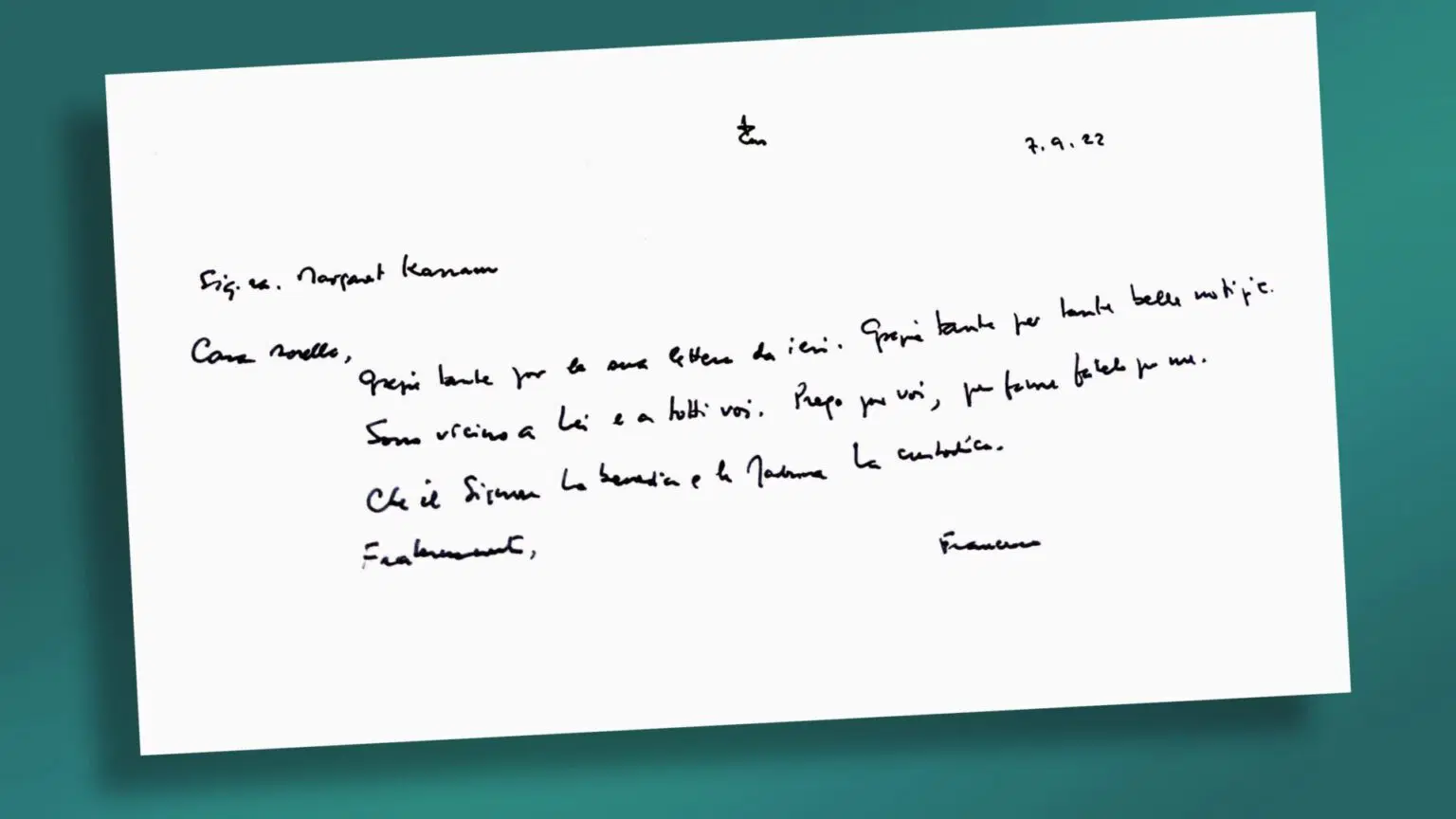
She was very surprised when the following day she received this handwritten reply from Pope Francis:

7.9.22

Ms Margaret Karram

My dear sister,

Thank you very much for your letter to me yesterday. I am grateful for so much good news.

I am close to you personally, and to all of you. I assure you of my prayers, please pray for me too.

May the Lord bless you and may Mary protect you.

Fraternally,

Francis


Jesus wants to give us true peace

On January 1st, on the occasion of the 55th World Day of Peace, Pope Francis stated in his message that: “Dialogue means listening to each other, discussing, agreeing and walking together. Fostering all this between generations means tilling the hard and sterile ground of conflict and waste to cultivate the seeds of lasting and shared peace”.

Chiara Lubich in this passage also invites us to establish relationships of dialogue in order to arrive at true peace.

“Jesus came to build totally new relationships between people, between man and woman, between boy and girl, between husband and wife, between parents and children, between teachers and pupils, between workers and employers, between employees and managers, between citizens and rulers, between race and race, between people and people, between state and state.

Jesus wants to build a new social order, based on justice, respect and true human fraternity. Jesus wants to give us, as individuals and as a community, true peace, that divine peace that he alone can give.

But, for this to happen, it is necessary to follow him, even if at first sight he seems to be so demanding. It is necessary to live his Word, each one in the condition of life in which he was called.”

Chiara Lubich


Pope: “Foster dignity and combat poverty to care for creation.”

In a message to members of the Focolare Movement at a conference on Integral Ecology, Pope Francis says the common good of the human family and the created world demands urgent action against poverty and injustice.

Pope Francis on Friday told participants in an online conference that we live in a time in which there is the urgent need for a new and more inclusive socio-economic paradigm that reflects the truth that we are “a single human family.”
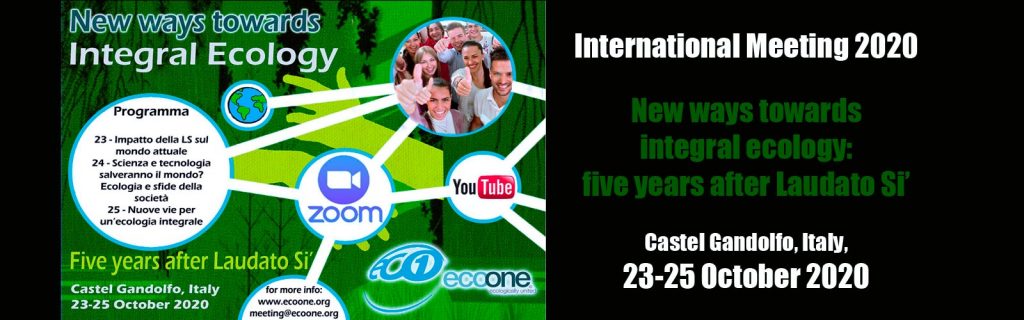
His words came in a  message to an international on-line Meeting, an event that is part of the year-long observance of the 5th anniversary of the Encyclical Letter Laudato si’.

“New ways towards Integral Ecology”

The Meeting, entitled “New ways towards Integral Ecology” was organized by “EcoOne”, the ecological initiative of the Focolare Movement in collaboration with the Dicastery for Promoting Integral Human Development and the Global Catholic Climate Movement.

He noted that the meeting addresses “a relational vision of humanity and care for our world from a variety of perspectives: ethical, scientific, social and theological,” and said he trusts that the Focolare Movement will be able to do much to promote awareness for the issue.

Charism of unity

The Pope recalled the conviction of Chiara Lubich, the foundress of the Movement, according to whom “the created world bears within itself a charism of unity.”

May her perspective, he said, “guide your work in the recognition that “everything is connected” and that “concern for the environment needs to be joined to sincere love for our fellow human beings and an unwavering commitment to resolving the problems of society” (Laudato si’, 91).

One human family

The Pope highlighted the need, today, to raise awareness that we are a “single human family, fellow travellers sharing the same flesh, children of the same earth which is our common home” (Fratelli tutti, 8).

He said that this solidarity demands “a firm willingness to develop and implement practical measures that foster the dignity of all persons in their human, family and work relationships, while at the same time combating the structural causes of poverty and working to protect the natural environment.”

The need for conversion

The Pope concluded calling for a profound interior conversion, both on a personal and communal level.

As we examine the great challenges of our time he said, including the contribution religion can make to the environmental crisis, “it is essential to break with the logic of exploitation and selfishness and to promote the practice of a sober, simple and humble lifestyle (see Laudato si’, 222-224).

Source: Vatican News