[:en]Download pdf
“Rejoice with me, for I have found my lost sheep” (Luke 15:6).
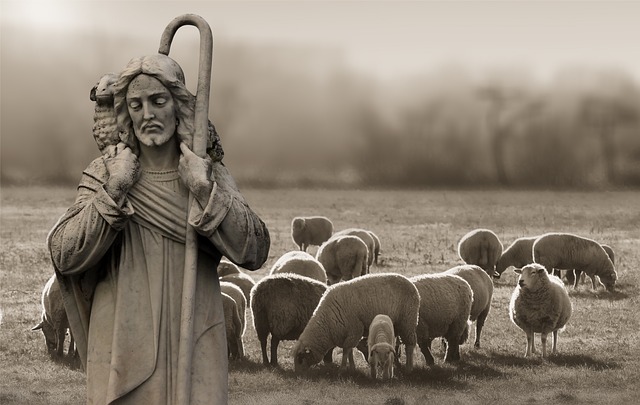
Shepherds in the Ancient East used to count sheep when they returned from the pasture and were always ready to set out in search if one was missing. They would even brave the desert and the night, in order to find those sheep that had gone astray.
This parable is a story of loss and finding again that clearly demonstrates the shepherd’s love for the flock. He notices that one of the sheep is missing, searches for it, finds it and carries it on his shoulders because it is weak, frightened, perhaps wounded and unable to follow the shepherd unaided. He brings the sheep back to safety and, finally, full of joy, invites his neighbours to celebrate together.
“Rejoice with me, for I have found my lost sheep.”
Three actions – getting lost, finding and celebrating – are the recurring themes in this story.
Getting lost. The good news is that the Lord goes out to find those who are lost. We often lose the way in the various situations we encounter or in which we live or even take refuge. These may include experiences of abandonment, marginalization, poverty, misunderstanding or disunity. They are like the desert where the path ahead is unclear. The shepherd searches for us even in these places, and although we may lose sight of him, he will always find us.
Finding. Let us try to imagine the scene of the shepherd’s frantic search in the desert. It is an image that is striking in its expressive power. We can understand the joy felt by both the shepherd and the sheep when they find one another: this encounter restores that sense of security to the sheep because it has escaped danger. Thus, the ‘finding’ is an act of divine mercy.
Celebration. The shepherd gathers his friends together to celebrate because he wants to share his joy, just as the main character does in the other two parables that follow this one: that of the lost coin and that of the merciful
father.(i) Jesus wants us to understand the importance of sharing joy with everyone and immunizes us against the temptation to judge each other. We have all been ‘found again’.
“Rejoice with me, for I have found my lost sheep.”
This Word of Life is an invitation to be grateful for the mercy God has for us all personally. Rejoicing and celebrating together present us with an image of unity, where there is no opposition between ‘righteous’ and ‘sinners,’ but we
share in each other’s joy. Chiara Lubich writes, ‘It is an invitation to understand the heart of God and to believe in his love. We are inclined to calculate and measure and sometimes we believe that even God’s love may grow weary… but God’s logic is not like ours. God is always waiting for us: indeed, we bring him immense joy every time – even though it be an infinite number of times that we return to him.’ (ii)
“Rejoice with me, for I have found my lost sheep.”
Sometimes we can be those shepherds, those caretakers, for one another and lovingly search for those who have drifted away from us, from our friendship or from our community. We can look out for the marginalized, the lost, the people driven to the peripheries by the trials of life.
A teacher told us ‘Some pupils didn’t come to classes regularly. When I was free, I used to go to the market near the school because I hoped to see them there because I knew some of them worked there to earn money. One day I finally found them. They were amazed that I had gone to look for them personally and were struck by the fact that they were really important to the whole school community. So they started to come to school regularly and it truly was a celebration for everyone.’
by Patrizia Mazzola & the Word of Life Team
i cf Lk. 15:8 & 15:11
ii C. Lubich Word of Life Sept 1986
https://soundcloud.com/user-63571203/word-of-life-september-2025?utm_source=clipboard&utm_medium=text&utm_campaign=social_sharing[:]