
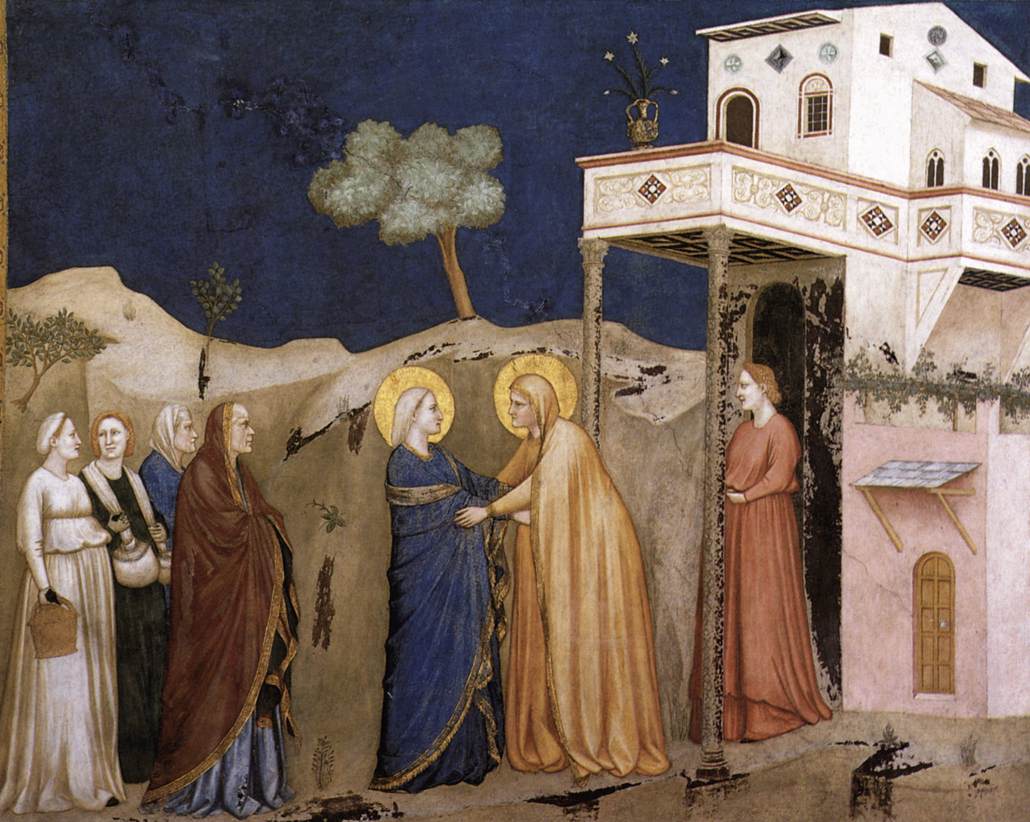
“My soul magnifies the Lord.” (Luke 1:46)
In the first chapter of his Gospel, Luke presents us with the only passage in the New Testament in which the main characters are two women, Mary and Elizabeth. Elizabeth lived in a village near Jerusalem, about 150 km from Nazareth.
Immediately after receiving the angel’s announcement that she would become the mother of Jesus (Lk 1:26–38), Mary sets out on a long journey to visit Elizabeth. We do not know the details of the route; we only know that she hurried towards the hill country. But why did she go there?
Mary went to share her joy with someone who, like her, had received a grace from God and had conceived a child. She wanted to be close to Elizabeth and help her during the final months before the birth of her baby. This is the story of two women and two experiences of pregnancy when conception seemed impossible. Who better than Mary could understand Elizabeth and share this time with her? The song of the Magnificat springs from their encounter.
“My soul magnifies the Lord.”
In his commentary on the Magnificat, Martin Luther wrote, ‘Her words are an expression of great love and profound joy; this explains why her life and soul are raised up in the Spirit. Mary does not say: “I magnify God”, but “my soul” does so. It is as if she is saying my whole life and my senses are, as it were, upheld by God’s love […]’ (i)
The verb ‘to magnify’ or to make great, reveals a feeling of joy that emerges from the discovery that God is even greater than one might have expected. This joy is echoed by profound humility and a deep sense of gratitude and appreciation.
Ermes Ronchi points out, ‘The Magnificat is Mary’s gospel, it is her good news that reaches all generations’. (ii) This young woman from Nazareth repeats ten times that it is “He who has done…”’. This seems like a new Decalogue, a new set of ten commandments that overturn the logic of the world.
It comes naturally to ask whether we have retained a sense of wonder and amazement in our daily lives and in our prayer regarding all that God has done and continues to do. Without openness and wonder as we encounter what is new and full of surprise, faith may become a weary prayer that gradually fades away and turns into nothing more than a social habit. (iii)
“My soul magnifies the Lord.”
Mary’s canticle is not merely a prayer of personal praise but a prophetic statement, characterised by a constant reference to passages from Scripture, which indicate God’s deepest desires for the future of humanity. (iv) To praise him means to stand alongside the least in society and to believe that the world can and must change.
The words of this hymn invite us to understand God’s saving intervention in our personal and communal history because they refer not only to our individual lives but to the entire universe. They extend from the present moment to the new heavens and the new earth that the social revolution of the Gospel inaugurates.
“My soul magnifies the Lord.”
The Magnificat invites us to transform our lives into a living form of praise by recognising the “great things” that are happening every day. It invites us to join with Mary in proclaiming that God is faithful, that his mercy extends from generation to generation and that his kingdom of justice and love is already being fulfilled among us.
Chiara Lubich had grasped this revolutionary dimension of Mary’s canticle when she wrote to a group of young people: “Read the Magnificat and you will find there the first and most powerful page of Christian social teaching.
Who and when will make these words into reality?” (v) The question remains open and challenges us. God’s intervention should not remain confined to the intimacy of the heart but must be manifested in our relationships, in life together and in the fabric of society for generations to come.
Prepared by Patrizia Mazzola
& the Word of Life Team
(i) Martin Luther, commentary on the Magnificat 1520
(ii) Ermes Ronchi, Magnificat, an open window upon the future, Avvenire Aug 2012
(iii) Pope Francis, Angelus, Rome 4 July 2021
(iv) Gerard Rosse, The Gospel of Luke 1992
(v) Chiara Lubich, Detti Gen, 1969
https://on.soundcloud.com/VxAlbglrInovywOcDf