
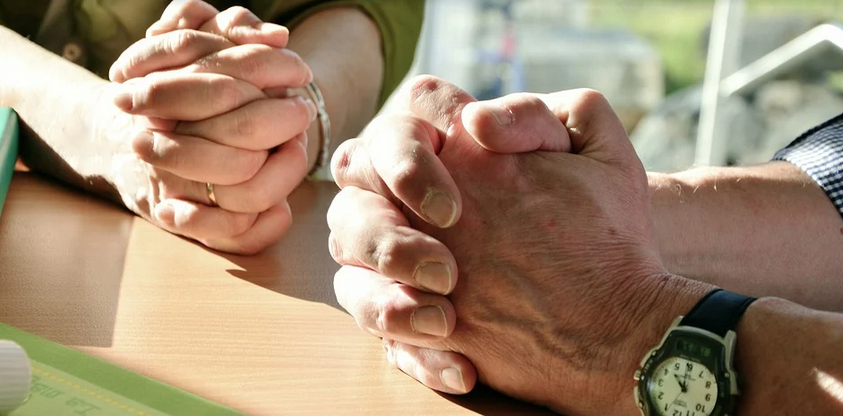
Prayer, in order to be such, firstly demands a relationship with Jesus”. Spiritual thoughts by Pasquale Foresi.
Praying does not consist specifically in dedicating time to meditation during the day, or in reading some passages of the Holy Scriptures or the writings of saints, nor in trying to think of God or of ourselves for our own inner renewal. This is not the essence of prayer. Neither is it only the recitation of the rosary nor of morning and evening prayers. These are certainly practices that help us to come in contact with God and express this intimate reality, which, however, never coincides completely with it.
Sometimes a person can do all this during the day and may not have even prayed for an instant. In fact, there’s a substantial difference between prayer and prayers, a difference which I shall try to explain, starting from that prayer that is mostly unconscious, but not less essential because of this.
When, we look up at night to watch the starry sky, we see a universe of unending beauty which enchants and amazes us in its silent obedience to a law: the law of life and harmony which from the beginning created it and sustains it every moment: This law alone bears witness to the Creator.
The same goes for the stars in the sky, and the plants and flowers that “know” when it is the time to blossom, and when to bear fruit and die. A profound rapport thus binds all living creatures to God, a relationship that – I dare say – is also a profound prayer because, with their being and their sole existence, they unconsciously recognize and follow that law, “narrating the glory.” (Psalm 18.2).
But this hidden prayer finds its highest expression – because it is free and conscious – also in the human person. It is that prayer which arises when, even before entering into a dialogue with God, we acknowledge him as the Father who created and sustains our being, on par with the entire universe. The relationship with God therefore emerges in its reality as a vital and healing element together all in one. And so, it’s a relationship in which the human person is called to establish daily with him, or to make requests of him, as some masters of the spirit do, in an original interpretation of the Our Father: “Give us today our daily bread.”
Prayer, in order to be such, firstly demands a relationship with Jesus: to go with him in spirit beyond our human condition, our worries, and our prayers, though they’re also beautiful and necessary, and to establish this intimate relationship with him.
Let us now look at some other ways through which this relationship can develop. I shall start from a type of prayer which apparently may not seem to be such, and this is the prayer of offering. This comes from those who, prostrated by physical or spiritual sufferings, are unable to do anything, even to speak, and who offer to God, even if for the span of just an instant, all their existence. This type of prayer may thus be considered the deepest one, since it embeds the soul in that point where our contact with God is immediate and direct.
But our daily work too can assume the characteristics of a prayer of offering. I refer particularly to those who, during the day, are overcome by physical fatigue, almost unable to gather the necessary energy to dedicate themselves to prayer. Well, if in the morning, they too make an intention to offer their day to God, they can feel that they are living in a continual dialogue with him, and in the evening, during the silence of even a brief moment of reflection, they will find union with him. In the end, this is what humanity today is particularly sensitive to, the fact that the entire universe and all that it does, can be transformed into an immense, unceasing prayer that is being lifted up to God.
Pasquale Foresi, from “Luce che si incarna” (“Incarnated Light”) – Ed.Città Nuova, Rome 2014, p. 31-33.

