
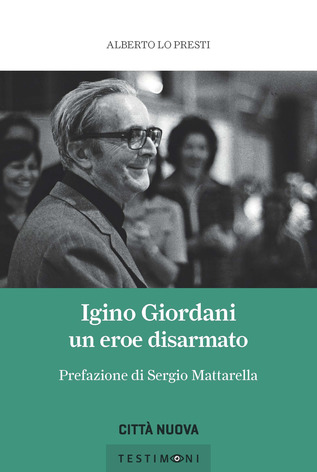
[:mt]“Un eroe disarmato”: dan hu t-titlu tal-bijografija ġdida dwar Igino Giordani. Saret il-presentazzjoni tagħha l-Ħadd 18 ta’ April meta l-Moviment tal-Fokolari fakkar il-41 anniversarju tat-tluq tiegħu lejn is-sema. F’din l-okkażjoni saret intervista lil Prof. Alberto Lo Presti u Dr. Elena Merli, l-edituri ta’ din il-bijografija u membri taċ-Ċentru Igino Giordani.
F’din l-intervista ħarġu ħafna affarijiet interessanti. L-ewwel mistoqsija kienet: għalfejn inkitbet bijografija oħra dwar Giordani meta ġa nkitbu diversi oħrajn? Dr. Merli wieġbet li l-bijografiji li nkitbu qabel kollha huma ta’ valur kbir, iżda dawn jitkellmu biss fuq partijiet mill-ħajja ta’ Giordani jew inkella janalizzaw xi aspett mill-ħajja tiegħu: l-aspett storiku, l-aspett spiritwali, l-aspett politiku…. Din kienet bijografija aktar kompluta u titkellem dwar aspetti li ftit li xejn kienu jissemmew qabel, bħal: il-ħajja tiegħu fil-familja, ir-relazzjoni profonda tiegħu ma’ Chiara, iż-żmien ta’ dawl partikulari magħruf bħala “il-Ġenna tal-‘49”. Dr.Merli qalet li hemm patrimonju enormi ta’ dokumenti, ittri, recordings, li permezz tagħhom setgħu jiskopru ħafna dettalji dwar il-ħajja ta’ Giordani.
Minn din l-intervista sirna nafu li l-ewwel bijografija dwar Giordani inkitbet fl-1936. L-awtur tagħha kien Bernardo Mattarella, missier Sergio Mattarella, il-President tar-Republika Taljana li kien mitlub jikteb l-introduzzjoni għal din il-bijografija ġdida. Fl-intervista, Prof. Alberto Lo Presti qal li l-President Mattarella kien jaf lil Giordani personalment, xi ħaġa li hu stess semma’ anki fl-introduzzjoni tal-ktieb. Qal ukoll li parti minn din il-bijografija hi ddedikata għall-impenn politiku ta’ Giordani, li għamel esperjenza tal-gwerra, ta’ żmien il-faxxiżmu, ta’ qerda u tbatija soċjali. U saħaq li x-xhieda tiegħu titfa’ dawl anki fuq il-ħajja tal-lum.
Interessanti dak li wieġeb Lo Presti meta kien mistoqsi: dan il-ktieb għal min hu intenzjonat? Wieġeb: “Dan il-ktieb hu għal dawk kollha li jixtiequ (…) jkunu jafu kif wieħed jista’ jagħti lilu nnifsu b’mod sħiħ lil Alla u jibqa’ jgħix l-affarijiet ordinarji fil-ħajja tad-dinja. Dan hu li rnexxilu jagħmel Giordani”. U kompla jispjega li għalkemm Giordani studja l-kitba ta’ Missirijiet il-Knisja, ta’ diversi teoloġi u ta’ nies spiritwali magħrufa, hu sab it-tweġibiet għall-mistoqsijiet li dejjem kellu meta ltaqa’ ma’ Chiara u mal-ispiritwalita’ ta’ komunjoni.
Lejn it-tmiem ta’ din l-intervista, Lo Presti rrakkonta episodju li hu sinifikattiv ħafna. Qal li Giordani kellu xewqa kbira li jagħti lilu nnifsu lil Alla b’mod sħiħ u għalhekk lejn l-aħħar tas-snin 1920 ingħaqad mat-Terz Ordni Dumnikan. Iżda ma tantx kien sodisfatt bir-regola tagħhom; xtaq li jinvolvi ruħu aktar f’ħajja reliġjuża. Offra idea li kellu lill-patrijiet: “Nikru appartament fejn nistgħu niltaqgħu lkoll flimkien: intom il-patrijiet biċ-ċoqqa u aħna l-lajċi bil-qalziet. U hekk inkunu nistgħu ngħixu ftit ħajja komunitarja flimkien”. Dan ma seħħx għax in-normi tal-Ordni Dumnikan kienu jgħidu mod ieħor.
Temm jgħid il-Prof. Lo Presti: “Dak li l-qalb ta’ Giordani kienet tixxennaq għalih fl-aħħar tas-snin 1920, sar realta’ permezz ta’ Chiara: kien il-fokolare”.
Source: https://www.focolare.org/en/news/2021/04/19/why-another-biography-of-giordani/[:en]
This is the question we asked Prof. Alberto Lo Presti and Dr Elena Merli, members of the Igino Giordani Centre, editors of “Igino Giordani: an unarmed hero” (Città Nuova Publications).
So many biographies have been written about Igino Giordani. Why another one?
Elena Merli: The previous biographies cover a limited time span of Giordani’s life. The first biography was written in 1936; then there was the one written by Tommaso Sorgi, a friend of Giordani who studied him in great depth. Sorgi wrote an inspired and detailed biography that deals with Giordani’s life from birth to 1948. Other biographies analysed Giordani’s life from a particular perspective: historical, spiritual, political…. They are all valuable; they are a great richness, but this biography deals with a holistic perspective of his life. It speaks about aspects that were very little explored until now, namely: his family life, his deep relationship with Chiara, the particular period of intense illumination that was “Paradise ’49”. Even his experience as a member of the Dominican Third Order had not yet been explored in depth. Some of the political background of his life had not yet emerged, nor were some of his intimate choices and delicate passages of his personal life. I would like to point out particularly the novelty of a chapter dedicated to what he jokingly called “Giordania”, that is, his family. I think many will enjoy reading about the secrets of Igino’s lively family situation.
The first thing that strikes you in this book is its prestigious preface signed by Sergio Mattarella, the President of the Italian Republic. Why him?
Alberto Lo Presti: It is good to know a few things from behind-the-scenes. First of all, Sergio Mattarella knew Igino Giordani personally, and he says something about this in the preface. Then, one must remember that his father, Bernardo Mattarella was the author of the first biography written in 1936. So, all this helped to ask him write the preface.
Then, we think that Sergio Mattarella is interpreting the role of President of the Republic as a source of unity in Italy and in the international field. During this health crisis, he has been a figure of stability and high morality.
Giordani gave witness to unity in politics and harmony among people. The parts of the book dedicated to his political commitment describe his behaviour during the war and in the post-war period, under bombings and fascism, amidst the rubble of reconstruction and social distress. Those times were not any calmer or more peaceful than the ones of today. Giordani’s steadfastness can still help us to understand where to go today.
This volume is the result of intense archival research work. Do we know everything about Giordani now?
Elena Merli: We have an impressive amount of material, documents, correspondence, and also audio and video recordings of many of Giordani’s talks, public and confidential ones, transcribed and sorted out. All these proved extremely useful to discover details about his personal life.
Who knows how many more new and interesting discoveries we can still make by exploring the archive! Many are already in this book. I’ll mention just one: details about Giordani’s last years, when he lived in this building, the International Centre of the Focolare Movement. At that time, the Focolare community of Antonio Petrilli occupied the first floor of this building, and in 1974, after the death of his wife Mya, Giordani moved to live with this community. These unpublished details reveal Igino’s faithfulness to community life and the depth of his humanity.
To whom is this book addressed?
Alberto Lo Presti: It addresses all those who want to solve the mystery of mysteries, that is, of how to be totally donated to God while immersed in the ordinary things of the world.
Giordani managed to do this and he traced the way for us. He always questioned himself about it ….. but when he met Chiara Lubich he also found the answers. For Igino, Chiara was the answer to all his existential questions. He studied early Christian writers, medieval theologians, modern theologians, great spiritual figures, yet he found the answers in Chiara and in the spirituality of communion.
I would like to recount one of the many anecdotes, which many do not know; one can find it in the book.
Giordani had such a great desire to donate himself to God that at the end of the 1920’s he joined the Dominican Third Order. But he was not satisfied … the rule for members was at least one Mass a month, a sermon by one of the monks and nothing more. He wanted to be more involved in religious life. So he submitted his idea to the monks: rent a flat where they could all meet: “you in your cassock (the monks’ cassock) and we, (the lay members) in our trousers. Thus, we can have some community life together”. He was told that this was not in the norms of the Dominican order and it stopped at that. What Giordani yearned for at the end of the 1920’s became a realty through Chiara; it was the focolare. Yes, in 1928 when such episodes happened, he was dreaming of the focolare. Incredible, isn’t it?
Edited by Lorenzo Russo
Publication available from Città Nuova
[:]

Malti
English
Add Comment