
In the following text that Chiara Lubich wrote during Holy Week in the year 2000, she suggested how to live these “holy days”.
Today is Holy Thursday! We feel that today is truly special because of the spirituality that flowed from the charism given to us by the Holy Spirit. So we want to pause for a moment to meditate, contemplate and try to relive the mysteries it reveals, together with those of Good Friday, Holy Saturday and Easter Sunday.
To begin with, each of these days could be given a title that expresses or, I would say, has proclaimed within the Movement for over 50 years what we should be: Love on Holy Thursday; Jesus forsaken on Good Friday; Mary on Holy Saturday; the Risen Lord on Easter Sunday.
Today, then, it is Love. Holy Thursday, this day on which, over the years, we have often experienced the sweetness of a special intimacy with God. It reminds us of the abundance of love that heaven has poured out over the earth.
Love, first of all, is the Eucharist, given to us on this day.
Love is the priesthood, which is a service of love and which among other things, makes it possible for us to have the Eucharist.
Love is unity, the effect of love, which Jesus, then as today, implored from the Father: “That they may all be one, as you, Father, are in me and I in you” (cf. Jn. 17:21).
Love is the new commandment that he revealed on this day before dying. “Just as I have loved you, you also should love one another. By this everyone will know that you are my disciples, if you have love for one another.” (Jn. 13:34-35). It is a commandment which enables us to live here on earth a life modelled on that of the Holy Trinity.
Tomorrow: Good Friday. Just one name: Jesus forsaken.
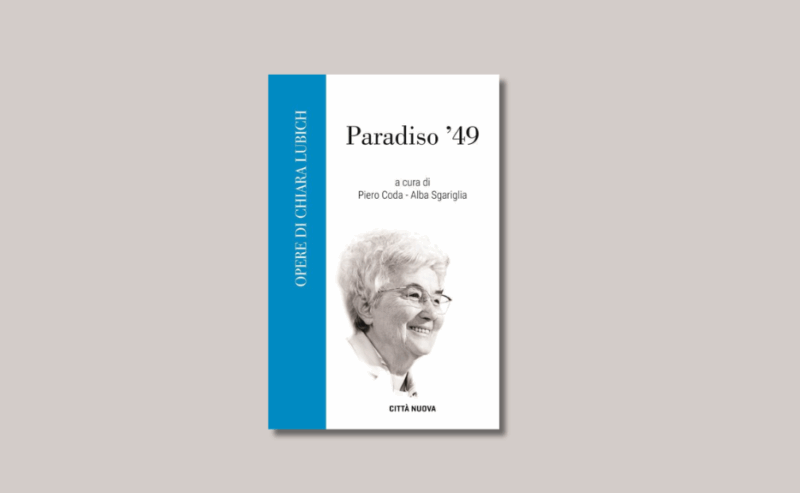
I’ve just written a book on him entitled The Cry. I dedicated it to him with the intention of writing it also on your behalf, on behalf of the entire Work of Mary “as – and this is the dedication – a love letter to Jesus forsaken”.
In it I speak of him who, in the one life God has given us, and on a day, a particular day that was different for each of us, called us to follow him, to give ourselves to him.
You can understand then – and I say so in the book – that what I want to say in those pages cannot be like a talk, however informal, warm, and deeply felt; but is, rather, a song, a hymn of joy and above all of gratitude toward him.
He had given everything: the life he lived beside Mary, in hardship and obedience. Three years of mission, three hours on the cross, from which he forgave his executioners, opened Paradise to the good thief, and gave his Mother to us. Only his divinity remained.
His union with the Father, that sweet and ineffable union with the One who had made him so powerful on earth, as Son of God, and so regal on the cross; that feeling of God’s presence had to descend into the depths of his soul and no longer make itself felt, separating him somehow from the One with whom he had said he was one. And he cried out: “My God, my God, why have you forsaken me?” (Mt. 27:46).
The day after tomorrow: Holy Saturday. Mary is alone. She is alone with her dead son-God. Is this a depth of anguish that cannot be filled, an infinite agony? Yes, but she remains standing, thus becoming a sublime example, a masterpiece of virtue. She hopes and believes. During his lifetime Jesus had foretold his death, but also his resurrection. Others may have forgotten his words, but she never forgot them. She kept those and other words in her heart, and meditated on them (cf. Lk. 2:51).
Therefore, she doesn’t give in to suffering: she waits.
And finally: Easter Sunday.
It’s the triumph of the Risen Jesus whom we know and relive in our own small way after having embraced him forsaken; or when we are truly united in his name and experience the effects of his life, the fruits of his Spirit.
The Risen Lord must always be present and living in us during this year 2,000. The world is waiting for people who not only believe in and love him in some way, but people who are authentic witnesses and who can truly say, as Mary Magdalene said to the apostles after having seen Jesus near the tomb, those words we know so well but which are always new: “We have seen him!” Yes, we’ve discovered him in the light with which he enlightened us; we’ve touched him in the peace with which he filled us; we’ve heard his voice in the depths of our heart; we’ve savoured his incomparable joy.”
Let us keep these four words in mind during these days: love, Jesus forsaken, Mary, the Risen Lord.
Chiara Lubich
(Taken from a telephone conference call, 20th April 2000)