7 December 1943: the beginning of a divine adventure

Chiara Lubich describes the day she consecrated herself to God.

On the 7th of December 1943 I went to church alone. There was a violent storm outside. It really gave me the impression that I had the world against me. (…) A small kneeler had been prepared for me before the altar, and I had a tiny missal in my hands. The priest had me pronounce the formula to give myself completely to God forever. I was so happy that I probably didn’t even realize what I was doing, maybe because I was young. However, when I pronounced the formula, I had the impression that a bridge was falling behind me and that I could no longer turn back because now I belonged entirely to God, therefore, I could no longer choose. At this point, a tear fell on my missal.

But my happiness was immense! Do you know why? I was marrying God, and I expected every possible good. It would be a divine, extraordinary adventure! I was marrying God! And later we saw that it had really been just that.

(…) What is my advice? I would give this advice to myself: we have only one life. Let’s aim high. Let’s risk everything to gain everything. It’s worth it, it’s worth it. So make this act of generosity: aim high, don’t hold back!

Excerpt taken from: Chiara Lubich, The fourth way, 30 December 1984

Photo: © Horacio Conde – CSC Audiovisivi

Source: www.focolare.org


16 July: Margaret Karram’s message on the day of the Pact of Unity

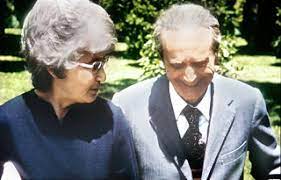
The 16th of July is a significant day for the Focolare Movement. In fact, it is the anniversary of the Pact of Unity between Chiara Lubich, foundress of the Movement, and Igino Giordani, whom she considered a co-founder. It took place on the 16th of July 1949.

On this anniversary, Margaret Karram, President of the Focolare Movement, addressed the following message to all those who belong to the Movement around the world.


Pope Francis: All in Christ

Jesús Morán, Co-President of the Focolare Movement, reflects on the years of his pontificate and highlights the “golden thread” that has woven his mission in guiding the Church.

It is with deep emotion that I write these lines about Pope Francis after his “flight” to the Father. I recall those many thoughtful and meaningful moments, when I was able to shake his hand and feel the warmth of his smile, the tenderness of his gaze, the strength of his words, the beating of his heart ready for a fatherly welcome. And I find it hard to believe that these encounters will no longer have a “tomorrow” or an “again” in my life.

I do not propose to make a thematic summary of Francis’ pontificate. To this end, it will be enough to review the many articles that have been published in recent days, especially the special issue of L’Osservatore Romano – just a few hours after his death – and the more or less exhaustive evaluations that will surely be published in the near future.

What moves me from within is to find that the golden thread that weaves his mission in guiding the Church, to try to be in tune with the centre of his heart and soul. And, from there, to relive the relationship he had with the Work of Mary during these twelve years.

To do this, I meditated deeply on his most recent talks, because I feel that this is where Pope Francis gave the best of himself and where you can find the key to all his thinking and to all his actions.

In the text he prepared for the Easter Mass, there is a quote from the great French theologian Henri de Lubac, who is also a Jesuit, that cannot simply be rhetorical: “it should be enough to understand this: Christianity is Christ. No, truly, there is nothing else but this.”

In my opinion, if we want to understand Francis, we must refer to this absolute: Christ, and only Christ, all Christ. From this we can understand the profound content of his encyclicals and apostolic exhortations, the choice of his journeys, his preferred options, the meaning of the reforms he undertook, his gestures, his words, his homilies, his meetings, and above all his love for those who are excluded, for those who are rejected, for women, for the elderly, for children and for creation.

‘No, there really is nothing else’. That is why one can say – using a pleonasm – that the Catholicism of Pope Francis is simply a “Christian Catholicism”. The new impulse he wanted to give the Church is based on this approach: the transparency of Christ. Because of this, on many occasions he has gone far beyond the politically correct, or rather, the ecclesially correct, without fear of being misunderstood, and without fear of being wrong, even aware of his “contradictions”. In fact, in an interview with a Spanish newspaper he said that what he wished for his successor was not to make his same mistakes.

Because of this Christological centrality, we can acknowledge that we have indeed been living – almost without realising it – with a Pope who is profoundly mystical. After all, this is how Pope Francis has thought and lived the Church: not as a religious organisation, nor as a distributor of sacraments, much less as a centre of economic, social or political power, but as the people of God, the body of Christ, which gives hospitality to humanity in His humanity. A Church, therefore, that is open to humanity, to service, because Jesus is “the heart of the world”.

To reduce Francis to a social reformer or a Pope of disruption shows a tremendous blindness. I often stared at his face when he inserted comments in his messages, for example at the Sunday Angelus. There, with the simplicity of a shepherd who passionately loves his flock, he displayed his harmony with the divine, his wisdom, his crystal-clear and straightforward faith, his profound humility.

In my humble opinion, from the centrality of Christ derive the two fundamental pillars of his magisterium: mercy and hope. Mercy is the expression of knowing ourselves as believers rooted in history, both personal and collective, with all its tragedies; hope manifests the eschatological and salvific tension that determines it. According to the Pope’s thought, there is mercy because there is hope; and it is hope that gives us a heart of mercy. Indeed, in his homily prepared for this year’s Easter Vigil, Francis affirms that ‘the Risen Christ is the definitive turning point in human history’. The important social and ecological messages of Pope Francis are misunderstood if this eschatological tension centred on the Risen Lord is not taken into account.

Francis’ relationship with the Focolare Movement has been very deep during the twelve years of his pontificate. He addressed ten official speeches to it: to the participants at the 2014 and 2021 Assemblies; to all those belonging to the Movement on the occasion of the 80th anniversary of its birth; to the academic community of the Sophia University Institute; to the family-focolares; to the participants at the meeting of the bishops of various Churches; to the participants at the meeting on the “economy of communion”; to the participants at the interreligious conference “One Human Family”; to the citizens of the little town of Loppiano; to the Mariapolis of Rome – Earth Village. Furthermore, on one occasion, he granted a private audience to Maria Voce, the first president of the Work of Mary after Chiara, and to myself.

What emerges from these meetings is a great love and a touching pastoral concern of Pope Francis for the Movement. In the virtual ecclesial circularity between hierarchical and charismatic gifts, we can affirm that, on the one hand, the Pope has been able to grasp, value and highlight the gift that the charism of unity, with its emphasis on the spirituality of communion and its concrete achievements in very different ecclesial and civic contexts, represents for the synodal process that the whole Church is living in view of a new evangelisation. On the other hand, he has identified with extreme clarity the challenges and steps that the movement must necessarily take if it wants to remain faithful to its original charism, knowing how to go through the inevitable post-foundation crisis in a humble way, transforming it into a time of grace and new opportunities.

Pope Francis has been for the world an all-encompassing message of fraternity rooted in Christ and open to all. Fraternity is the only future that is possible. We, the people of unity, must treasure this legacy with humility, energy and responsibility.

Jesús Morán

Photo © Vatican Media
Source: https://www.focolare.org/en/pope-francis-all-in-christ/


Be an “Easter People”

With this excerpt from a message Chiara Lubich gave us for Easter 1994, we wish each other a Happy and Holy Easter!

“Dear all,

Easter, the greatest feast of the year will soon be here and with it Holy Week, which abounds with the most precious mysteries of Jesus’ life. We are reminded of these … on Holy Thursday, Good Friday, Holy Saturday, and Easter Sunday, and for us, they represent central aspects of our spirituality.

We celebrate them with the Church through the holy liturgy, but because ours is a ‘way of life,’ we also honour them with our lives.

How should we live these blessed days of the year? I think that the best way to live all of them, is to live “Easter”, that is to allow the Risen Lord to live in us.

And in order for the risen Lord to shine out in us, we have to love Jesus Forsaken and always be, as we say, “beyond the wound,” where charity is queen. Then charity will urge us to actively be the new commandment; charity impels us to draw near to the Eucharist which nourishes divine love in our hearts …; charity leads us to live in unity with God and with our neighbours. In a certain way, it is through charity that we can be another Mary.

Yes, the best way to live the various aspects of Jesus’ life recalled during Holy Week is by proposing to allow the Risen Lord to live in us

Dear friends, this is what we would like to propose to you and this is what we are trying to live. By doing so, all of us together will truly be the “Easter People”. And as a consequence, we will better understand the passion, death and resurrection of Jesus.

Chiara Lubich


Margaret Karram’s Christmas greetings

Margaret Karram, President of the Focolare Movement, in her greetings for Christmas 2024, invites us to ask the Child Jesus to open our hearts to ever truer and more welcoming relationships.

Christmas Message

I would like to send greetings to everyone in the world, the most beautiful Christmas greetings.

But first, together with all of you, I would like to thank Jesus,

because first of all he became small, he loved us first

and he taught us what being close means and what it means to love beyond measure.

So, let’s ask him to open our hearts, more than ever, to authentic and true relationships

and to be completely welcoming, so that we can truly

be bearers of peace and of hope for each person.

Happy Christmas to everyone!

Margaret Karram


Living the charism of unity today

16 July 2023

Dearest everyone,

The 7th of December 2023 will mark the eightieth anniversary of the birth of the Focolare Movement, and as we approach this date, I have a question that has been close to my heart for some time: “What does it mean today to live the charism of unity?”

I felt the desire to recollect myself, to search deeply and to go back to the roots so as to understand what God wants to tell us, as we renew the Pact of Unity that was first made by Chiara and Igino Giordani (Foco). So, I asked Piero Coda to offer us his reflection on the relevance of the Pact, so that we can live it today with greater awareness and in a more radical way.

I would like each of us to look up to Heaven, to look at everything we have received from God and to draw Love from him, the One who is the source of Life.

Margaret Karram


Read spiritual reflection by Msgr Piero Coda (Secretary General of the International Theological Commission)


“Today is Holy Thursday, our feast day.”

A meditation by Chiara Lubich for Holy Week

Today is Holy Thursday, our feast day. Like today, many years ago, Jesus gave his disciples the new commandment, the commandment which is the fundamental law and the basis of every other rule for each of us. Like today, Jesus prayed for unity: ‘May they all be one’. Like today, he instituted the Eucharist which makes him present among us and in fact brings about our unity with Him and with one another. And like today, he instituted the priesthood that makes the Eucharist possible. All of this in one day.

What more do we want? It’s our feast day and we have often lived this day with great emotion in our heart, an emotion we don’t experience at any other time of year. Now is the time to say thank you to Jesus, a huge thank you that wells up from the depths of our hearts and reaches up to heaven.

What would our life be like without the new commandment, without the Eucharist, without the ideal of unity?

Chiara Lubich

Lake Constance (Switzerland), 16 April 1981


Chiara Lubich: Christmas with those who suffer

In a few days it will be Christmas. It’s a celebration when we can meet up as a family and renew relationships, regardless of the lights and the gifts. God became a child and was born in the poverty of a manger. On Christmas Day 1986, Chiara Lubich invited the communities of the Focolare Movement to go out towards those who are suffering the most. Today too, we have many brothers and sisters who are having to live in situations of suffering and they are waiting for us to share with them and to bring them comfort.


“Today the warmth of the Christmas spirit makes us all feel more like a family, more united as one, more like brothers and sisters, so that we want to share everything, both joys and sorrows. Above all, we want to share the pain of those who, due to various circumstances, are suffering.

Suffering!

Suffering can at times overcome our entire being, or occur suddenly and mix bitterness with the pleasant moments of our day.

Suffering caused by an illness, an accident, an ordeal, a painful circumstance. …

Suffering! …

If we look at suffering from a human standpoint, we are tempted to look for its cause either within us or outside of us, for example, in human malice, or in nature, or in other things. …

And all this might be true, but if we think only in these terms, we forget something more important. We lose sight of the fact that underlying the story of our lives is the love of God who wills or permits everything for a higher purpose, which is our own good. …

And didn’t Jesus himself, after inviting us to take up our cross and follow him, then affirm, “Those who lose their life” – and this is the apex of suffering – “will find it”?[1]

Suffering, therefore, brings hope of salvation.

So what can we say today to our friends who are struggling with pain and suffering?  …

Let’s approach them with the greatest possible respect, because even though they may not think so, in this moment they are being visited by God.

Then, inasmuch as we can, let’s share their crosses, which means to truly keep Jesus in the midst with them. Let’s also assure them that we are continually with them, and assure them of our prayers, so that they will be able to take directly from the hand of God whatever makes them suffer, and unite it to the passion of Jesus so that it can produce the greatest possible fruit. …

And let’s remind them of that marvelous Christian prin­ciple of our spirituality, by which suffering that is loved as a countenance of Jesus crucified and forsaken can be transformed into joy.

May this be our …  Christmas/OR  commitment – to share every suffering with our brothers and sisters who are suffering the most, and offer our own sufferings to Baby Jesus.”

Chiara Lubich


Chiara Lubich: Building oneself up in prayer

From the telephone Linkup with Focolare communities around the world – Palermo, Italy, 22 January 1998.

Copyright 2022 © CSC Audiovisuals – All rights reserved. (2661M)


Chiara Lubich: “Kindle fires” of unity

The Gospel text chosen for the month of November 2022 encourages us to practice mercy towards our brothers and sisters. In this passage from 15 October 1981, given during a worldwide telephone conference call, Chiara Lubich invited all listeners to revive this merciful love characteristic of the early days of the Focolare Movement. It is an appeal that today too can help us to grow in our personal journey of union with God and with the community.

What I want to focus on today is unity. Unity must triumph: unity with God, unity among all people. The way to achieve this is to love everyone with that merciful love which characterized the Focolare at its beginnings, when we decided that each morning and all through the day we would look upon every person we met at home, at school, at work, everywhere as a new person, brand new, deliberately not remembering any of his or her shortcomings or defects, but covering everything over with love. … to reach out to everyone we meet with complete “amnesty,” universal pardon, in our hearts; and then to “make ourselves one” with them in everything except sin and evil.

Why should we do this? To obtain the same wonderful results the Apostle Paul was seeking when he said: “For though I am free with respect to all, I have made myself a slave to all, so that I might gain all the more. I have become all things to all people” (1 Cor. 9: 19,22). If we “make ourselves one” with our neighbour, as Paul recommends, which will be easier when we have this forgiving attitude, we will be able to pass our “Ideal” on to others. And once this has been accomplished, we can have Jesus present among us, the risen Jesus who promised to remain with us forever in his Church, and who allows us to almost see and hear him when he is in our midst.

This must be our principal work: to live in such a way that Jesus may live among us – Jesus, who is victorious over the world. For if we are one, as time goes on many will be one, and the world will someday be able to witness unity.

So, let’s create cells of unity everywhere, each a focolare – a hearth, burning with love: in our family, on our block, with our playmates, with the people at work or at school – with everyone we can. Let’s kindle fires of love everywhere

Chiara Lubich